








AI

AI Agent Platform

Learn what an AI agent platform is, how it is built, and when it makes sense, with an overview of open options.

Our clients

Clients and partners

Capital Group
FSK Group
SMLT
Tochno
Dogma
Sber City
FM Logistic
Danone
Relief Center
Pandora
AI Agent Platforms: What They Are and Why They Matter
Saint-Gobain
Askona
FIX PRICE
Snezhnaia Koroleva
Muztorg
TVOE
Greenway
Polaris
Campari
Yandex
Lenta
International perfume and cosmetics brand
AI Agent Platforms: What They Are and Why They Matter
RAEC
EKF
L'Etoile
Inventive Retail Group

What an AI agent platform is

An AI agent is a program that receives a goal, decides on its own which steps to take, and calls external systems to execute them. One agent can be written in a few days and almost always works in a demo. Problems begin when there is more than one agent, they live longer than a single session, and they touch production systems.

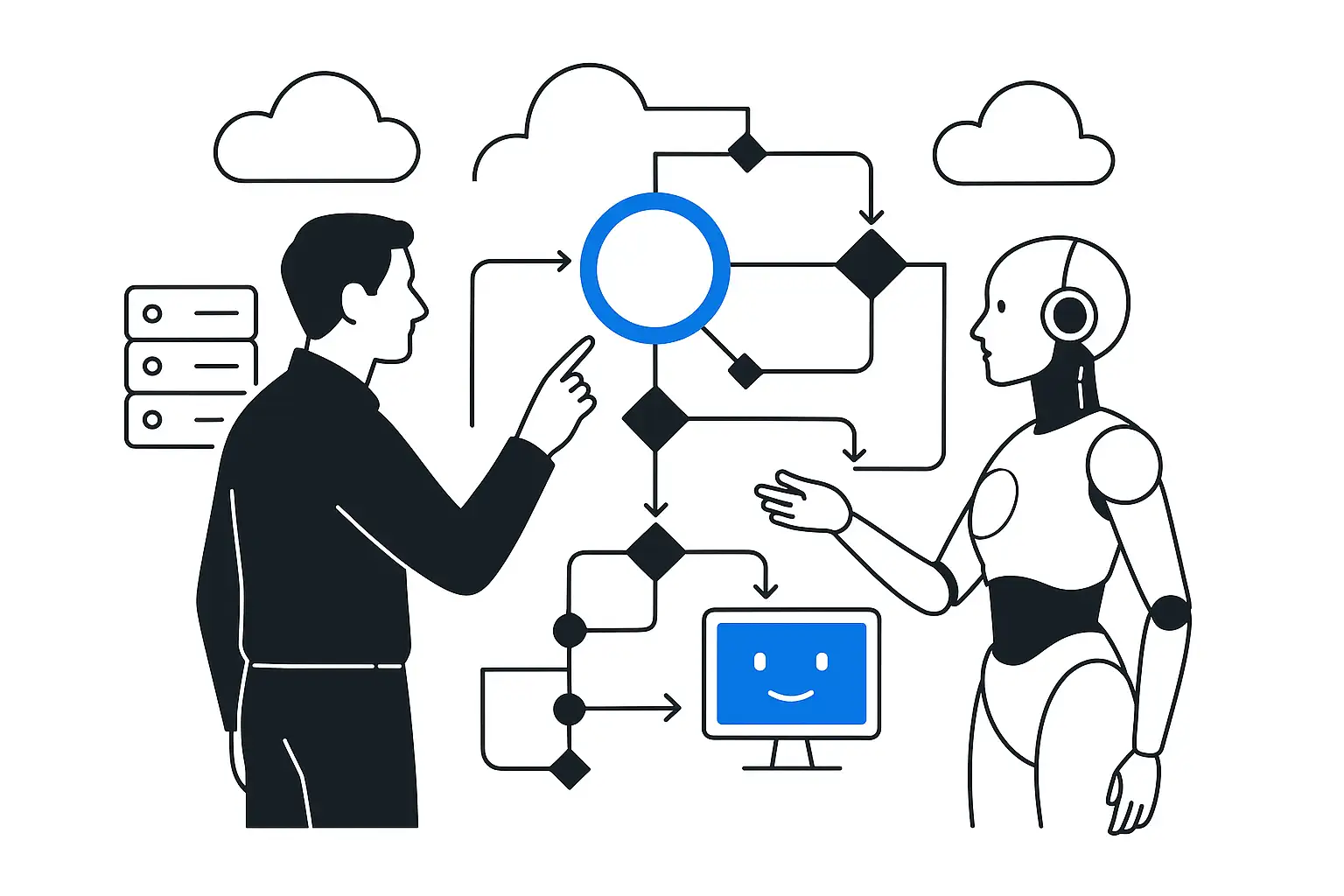
An AI agent platform is the shared layer that handles everything around the model: starting and stopping the agent, its memory, access to data and tools, the action log, permissions, and the points where a human confirms the decision. In this setup, the model is replaceable, the platform is not.

It is important not to confuse three different things. Framework (LangGraph, CrewAI) - a library from which a developer assembles an agent in code. Visual builder (Dify, n8n, Flowise) - an environment where a workflow is assembled with a mouse and immediately gets a UI and API. Platform what remains when you have dozens of agents: a single registry, shared access to tools, observability, and governance. The first two often grow into the third, but do not become it automatically.

What is happening in the market

40%enterprise applications will contain agents for specific tasks by the end of 2026, up from less than 5% in 2025 (Gartner)
> 40%agent projects will be shut down by 2027, due to weak orchestration and governance, not model quality (Gartner)
97MSDK downloads for the MCP protocol per month as of February 2026
150+organizations were using the A2A protocol in production as of April 2026

Why it is needed: what breaks without it

Gartner's forecast that more than 40% of agent projects will be shut down is not about the models. Operations break down, and they do so predictably.

Agent sprawl. Departments launch their own agents independently. Six months later, the company has two dozen of them, half have no owner, and no one can say which ones access the production database or with what permissions.

Loss of context between handoffs. An agent hands off a task to another agent, and with it the history is lost: why the decision was made, what has already been checked, what is forbidden. According to 2026 data, about 22% of production deployments already coordinate three or more agents - meaning handoff has become the norm, not the exception.

No human in the loop for high-cost actions. As long as the agent is only reading, there is no risk. Once it starts sending documents, changing prices, or writing to an accounting system, you need a point where an employee confirms the decision and an audit trail to investigate the incident later.

Nothing to show in a review. Without tracing, there is no answer to the question of why the agent did it. That stops adoption faster than any technical limitation.

What the platform consists of: layers and who is responsible for what

System / layerScope of responsibility
Orchestration and RuntimeAgent loop execution, steps, retries, timeouts, stopping. This is also where state lives: checkpoints, rollback to the previous step, and task handoff between agents.
MemoryWhat the agent remembers within a step, between sessions, and for a specific user. Separately, where that memory is stored and how to clear it on request.
Knowledge and search (RAG)Access to corporate documents and data with source attribution for answers. Without this, the agent responds plausibly but not verifiably.
Tools and MCPA catalog of actions in external systems: accounting, CRM, warehouse, and email. The MCP protocol has become the de facto integration standard here.
Models and InferenceWhich models are available, where the data goes, and what to do if the provider is unavailable. This is where the deployment boundary and Federal Law 152 are decided.
Observability and EvaluationsEnd-to-end decision tracing, quality metrics, regression tests. It answers why the agent did something, not only how long it took.
Governance and securityPermissions, limits, human approval, audit. The only layer that cannot be added later without reworking the others.

What the platform simplifies in development

What the platform simplifies in operations

Assess where AI can deliver impact in your process

When a Platform Is Justified, and When It Is Overkill

A Platform Is Needed

  • There are more than two agents, and they appear across different departments
  • The agent performs actions in production systems, not just text replies
  • Data cannot be sent outside: you need your own environment and control over where the request goes
  • Auditability is required: who acted, when, and on what basis
  • Agents hand tasks off to one another and run longer than a single session

The Platform Is Overkill

  • One scenario, one department, read-only access - a framework or ready-made service is enough
  • A two-week pilot whose goal is to test the hypothesis itself, not survive it
  • There is no process owner: the platform will not create accountability, it assumes it.
  • The team is not ready to run yet another system - the platform will add work, not reduce it.

Open Platforms and Frameworks: What People Choose in 2026

Below is what is actually available for deployment. The license matters more than features here: some popular solutions are formally open, but restrict commercial use.

SolutionClassLicenseWhen to Use It
LangGraphFramework, codeMITLong-running workflows with state, checkpoints, and step-back recovery; human in the loop
CrewAIFramework, codeMITMultiple agents with roles and task separation; quick start
Microsoft Agent FrameworkFramework, codeMIT.NET and Azure ecosystem; the successor to AutoGen, now in maintenance mode
DifyVisual platformApache 2.0 with caveatsBuild workflows with a mouse, along with RAG, observability, and API in one service
n8nVisual automationSustainable Use LicenseProcess automation with agent nodes and hundreds of ready-made integrations
Flowise, LangflowVisual buildersOpenAgent and RAG prototypes without coding
openJiuwen (Huawei)Memory ComponentsOpenSelf-learning agent memory; the community published AutoGenetic Memory on July 1, 2026

Two caveats to check before choosing. n8n is distributed under the Sustainable Use License: this is not an OSI-approved open license - internal use is free, but resale as SaaS requires a commercial agreement. Dify uses an Apache 2.0 license with additional terms for branding and multi-tenancy, they need to be reviewed before building a product on it.

Protocols: MCP and A2A

The two standards address different tasks and are used together in 2026 projects.

MCP describes how an agent gets access to a tool or data source. This is the vertical agent-to-system connection. By February 2026, the protocol SDKs were being downloaded about 97 million times per month, all major model providers had adopted it, and API gateway vendors were embedding MCP support into their products.

A2A describes how agents coordinate with each other and hand off tasks - the horizontal connection. As of April 2026, more than 150 organizations were using the protocol in production. In March 2026, Huawei announced the open sourcing of A2A-T, an industry extension for telecom.

The practical conclusion is simple: tools connect through MCP, and task handoff between agents happens through A2A. A platform that supports neither will lock you in at the integration layer.

How to Choose a Platform

  1. 01

    Decide how many agents there will be in a year

    If there is one, choose a framework. If there are more than five across different departments, choose by the control layer, not by how easy it is to assemble the workflow.

  2. 02

    Check the license before the pilot

    Open source and commercial use rights are different things. n8n's Sustainable Use License and Dify's Apache 2.0 caveats change the product model.

  3. 03

    Define the deployment scope

    If data cannot leave, the platform must be deployed on your own infrastructure, and model access must go through a gateway with request logging.

  4. 04

    Require tracing and evaluations

    Without an end-to-end decision log and regression checks, you cannot investigate an incident or safely change prompts.

  5. 05

    Ask about MCP and A2A

    Standards support determines whether you can switch platforms in two years without rewriting integrations.

  6. 06

    Assign a process owner

    The technical layer does not create accountability for results. An agent without an owner becomes the kind of unmanaged agent seen in the statistics.

What we do

KT.Team deploys the listed open platforms within the customer's environment: we set up orchestration, connect enterprise sources through RAG and MCP, put in place a model access gateway with request logging, and configure tracing and permissions before the agent gets write access.

The working approach is the same as in our other AI projects: we take one process, bring it to a working state and acceptance, and only then expand the scope. Details on related topics are on the pages LLM gateway, MCP, n8n and an enterprise knowledge base on RAG. Federal Law GDPR requirements are covered separately: compliance with Federal Law GDPR and protection of personal data information systems.

Sources

Verified on: 2026-09-01

Cases

AI implementation cases

Read all

Discuss: AI Agent Platform

Send via: