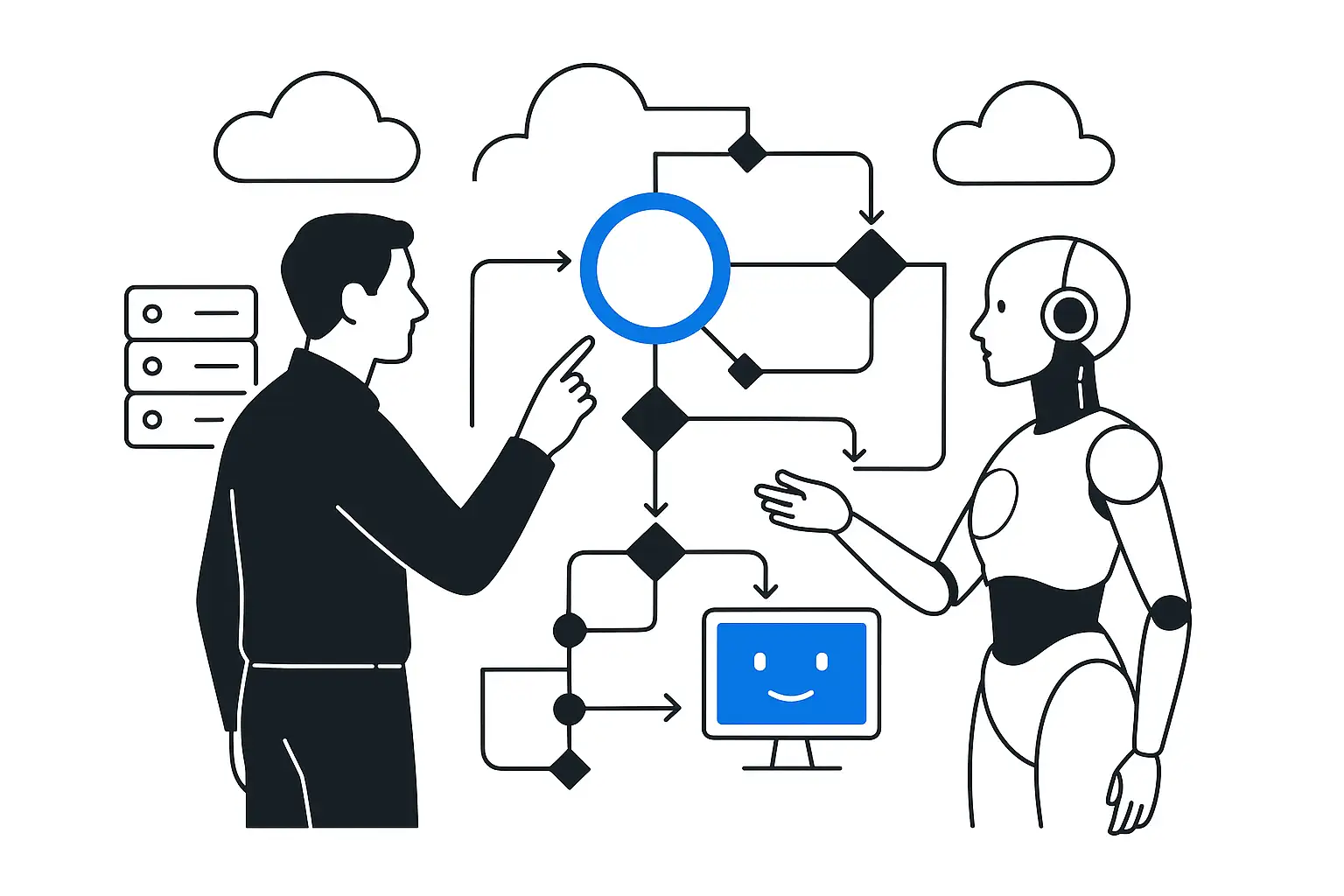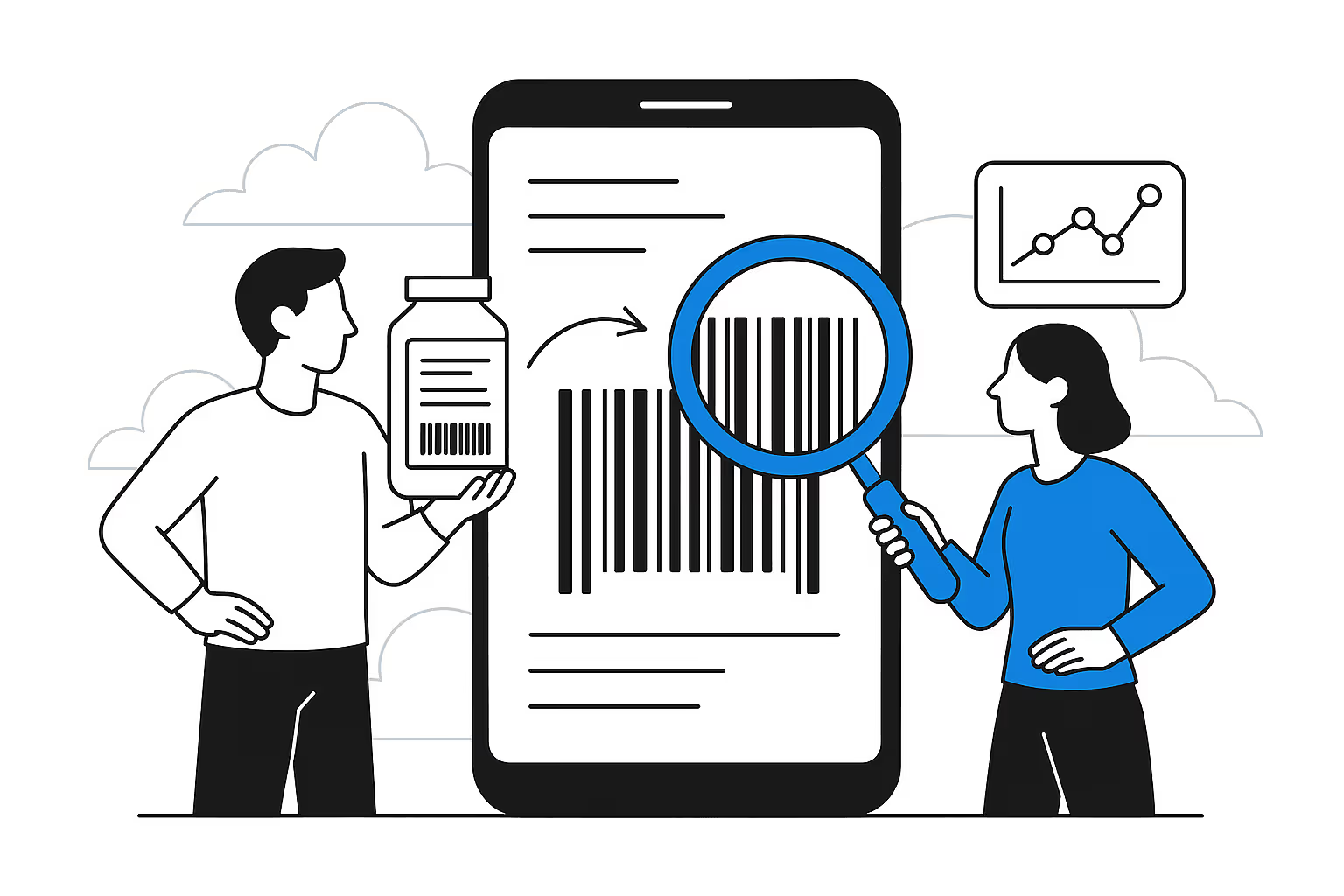
Process analysis and acceptance criterion
We measure manual operations and time to completion, then agree on a verifiable result. Without this measurement, the impact cannot be proven, making it impossible to secure the budget for the next process.

We build an agent on open-source engines in your environment and bring it to production with real data in 1–2 weeks. The code, data, and access rights remain yours, while the agent’s actions are logged, allowing the solution to pass information security approval. The indicative cost for a standard process is $3,600 excluding VAT, with payment after acceptance.
Our clients












An agent differs from a chatbot not by its model, but by its authority to act. A chatbot responds with text, and that is where it ends. An agent receives a task, determines what data it lacks, retrieves it from your systems, performs permitted operations, and stops where human approval is required.
This leads to a practical requirement that usually determines project success. An agent needs access, not prompts: to 1C, CRM, email, documents, and regulations—with permissions, logging, and a control point. That is why we design agents around data exchanges and permissions, not dialogue flows: behind our integration layer are 77 published enterprise cases from 13 years of work with PIM, ESB, WMS, and 1C.
What this looks like in practice is shown in review of open agent platforms: the technical layer is now available to everyone and costs almost nothing; the difference between a working agent and a demo lies in integration, permissions, and process ownership.
Offer
From $3,600 excluding VAT · 1–2 weeks
We take one repeatable process, build the agent within your environment, and test it on real data. We fix the exact price after reviewing inputs, outputs, and integrations; payment is due after acceptance. We agree on the definition of done before starting, so acceptance is not disputed.
We measure manual operations and time to completion, then agree on a verifiable result. Without this measurement, the impact cannot be proven, making it impossible to secure the budget for the next process.
We deploy on open components in your infrastructure or private cloud. There is no mandatory subscription to our platform: the code remains yours.
We connect regulations, documents, CRM, and 1C through MCP and the corporate knowledge base. We configure access rights and request logging before the agent receives write access.
Material actions require human confirmation. Every agent request to models and systems is logged, so incidents can be investigated instead of guessed at.
Power users learn to change the rules themselves, while IT learns to maintain the environment. The goal of the iteration is for you to take the next step without a contractor.
After acceptance, we compare the result with the baseline using the same criterion. If there is no impact, the figures will show it—not a report describing work completed.
The agent selects suitable procedures by your criteria, analyzes the terms of reference, and prepares a draft estimate. Details on the page AI for tenders.
Document recognition, reconciliations, bank statements, and journal-entry preparation under the chief accountant’s control. See AI accounting assistant and 13 accounting scenarios.
An employee describes the task in plain language; the agent reads the data and performs permitted operations through MCP and a security gate. Learn more — AI agent for 1C.
Answers based on regulations, contracts, and documents with a source link, not a paraphrase from memory. See corporate AI assistant.
Reviewing incoming requests, preparing responses and commercial proposals, and removing routine work from managers. See AI sales assistant.
Checking whether work and documents comply with rules in manufacturing and construction. See AI quality control and AI estimator.
Before work begins, the project manager and process owner define a measurable “done” criterion.
A developer builds the agent on open components within your infrastructure.
We connect regulations, documents, and systems through MCP and a knowledge base; access rights are granted on a least-privilege basis.
We test real cases, including exceptions, and add security gates and human confirmation.
Power users learn to change the rules, while IT learns to maintain the environment. From there, you develop the agent yourselves.
An AI agent pilot is more often held up by approvals than by technology. Security teams and technical directors ask the same questions in every project, and they need answers before launch, not at acceptance.
Where the data goes. Requests to models pass through a logged gateway, so the question “what exactly left the perimeter” is answered by the log, not by guesswork. If data must stay within the perimeter, models are deployed on your infrastructure; if you have no suitable hardware, services hosted in CIS data centers are used.
What the agent can do independently. Access rights are granted on a least-privilege basis, separately for reading and writing. Material actions—posting entries, sending to a counterparty, or changing data in an accounting system—require confirmation from a responsible person. The agent prepares the decision but does not sign it.
How to investigate an incident. Every agent step—what data it requested, what it decided, and why—remains in the trace. Investigating an incident becomes a matter of reading the log, not reconstructing events from indirect clues.
Who will maintain it a year from now. The solution is built on open components with permissive licenses and runs in your infrastructure. Your IT department can maintain it, not just us: we build this requirement into the project rather than merely promising it. The engines used and the reasons behind them are explained in review of AI agent platforms.
The $3,600 estimate covers a typical process: analysis, deployment in your environment, data connections, security gates, testing with real data, and team training. The exact figure depends on three things: how many systems must be connected, how clean the input data is, and how many rule exceptions there are.
The remaining cost is ongoing operation, which must be calculated separately: models, the access gateway, and support. We calculate it per user-day, not per abstract million tokens, so it can be compared with the salary of the person currently doing the work manually. The full calculation with a calculator is in the analysis how much an AI agent costs and what makes up its TCO.
Each subsequent iteration costs less than the first: the environment, access, and team skills are already in place. That is why we do not charge a subscription fee—the next process starts when it is genuinely needed.
A note on operations: in September 2026, costs fell significantly. Anthropic cut prompt-cache read prices fourfold, which is the main cost for long-running agents that repeatedly reread regulations, data schemas, and work history. As a result, calculations based on first-half prices now overstate operating costs. The latest figures and daily operating-cost formula are explained in how much an AI agent costs and in 2026 model comparison.
First step
30 minutes
Choose an area with significant repetitive manual work: tenders, source documents, customer replies, reporting, or document search. In the first conversation, we will assess the manual workload, data availability, process owner, and verifiable result for the first iteration.
Cases