Where Claude Thinks: AWS in India and Seoul

AWS processes Claude data in India, Korea, and Singapore. Learn how to meet CIS’s GDPR requirements with an LLM gateway.

  • What AWS actually launched
  • Why the Region Matters More Than a New Model
  • What this looks like in CIS
  • How this is addressed technically

Trigger

In one month, AWS made Claude available in Amazon Bedrock with data processing inside the country. In India Opus 5, Sonnet 5, and Haiku 4.5 are available, in Seoul - Opus 5 and Sonnet 5, in Singapore - Sonnet 5.

Bedrock will not be useful to a CIS company, but the lesson from these releases applies directly to it. Where a model processes data has become an architectural parameter on the same level as database selection. It should be decided before the pilot, while the security team has not yet written its letter.

What AWS actually launched

Inference is the processing of a request by a model: the text is sent to a server, the model calculates a response, and returns it. Bedrock distributes requests through cross-Region inference profiles, spreading the load across multiple data centers to handle peaks.

A global profile can send a request to any region in the world. For

For India, AWS created a geographic profile: requests are processed only in Mumbai and Hyderabad. In Seoul and

In Singapore, AWS restricted processing even further:

  • according to her
  • the request is processed in that region
  • where it was sent
  • and does not leave its borders

AWS names its target audience directly: finance, healthcare, and the public sector.

In our experience, companies in these industries have kept LLMs in a sandbox and out of production in recent years because their lawyers would not approve cross-border data transfers. During the same weeks, AWS added xAI's Grok 4.7 to its catalog, with a 500,000-token context and four levels of “reasoning effort,” from low to xhigh.

It is available only through cross-Region profiles

AWS adds models to its catalog faster than a customer's lawyers can approve even one.

Why the Region Matters More Than a New Model

  1. In a regulated company, a pilot using anonymized data usually succeeds.

  2. Then the security team asks which country processes the request, and the project stalls for months.

  3. In our integration projects, approving data access often takes longer than development.

  4. This is an observation from our practice; there are no industry statistics on it.

  5. We measure AI value through TTU - time to use: the time from an idea to the first real document processed by the model in production. AWS shortens the longest part of this journey by moving computation where the regulator permits it. Model quality remains unchanged.

  6. The legal status changes: it is approved for use with real data.

What this looks like in CIS

GDPR requires the personal data of CIS citizens to be collected and stored in databases located in CIS. Cross-border transfers must be reported to Roskomnadzor, and transfers to certain countries are restricted. Banking and trade secrets, as well as internal policies, add further requirements. Claude, OpenAI, and Gemini run on foreign servers.

Within the controlled environment, GigaChat, YandexGPT, and open models - Qwen and Llama on in-house GPUs - are available.

Companies usually make one of two mistakes

First: management completely bans external models and accepts noticeably worse quality on complex tasks. Second: management officially bans nothing, and employees paste contracts into a chatbot from a personal account.

In the second case, the data leaves the country, with no record of it in the company's logs.

Assess where AI can deliver impact in your process

How this is addressed technically

AWS solves the problem through geography

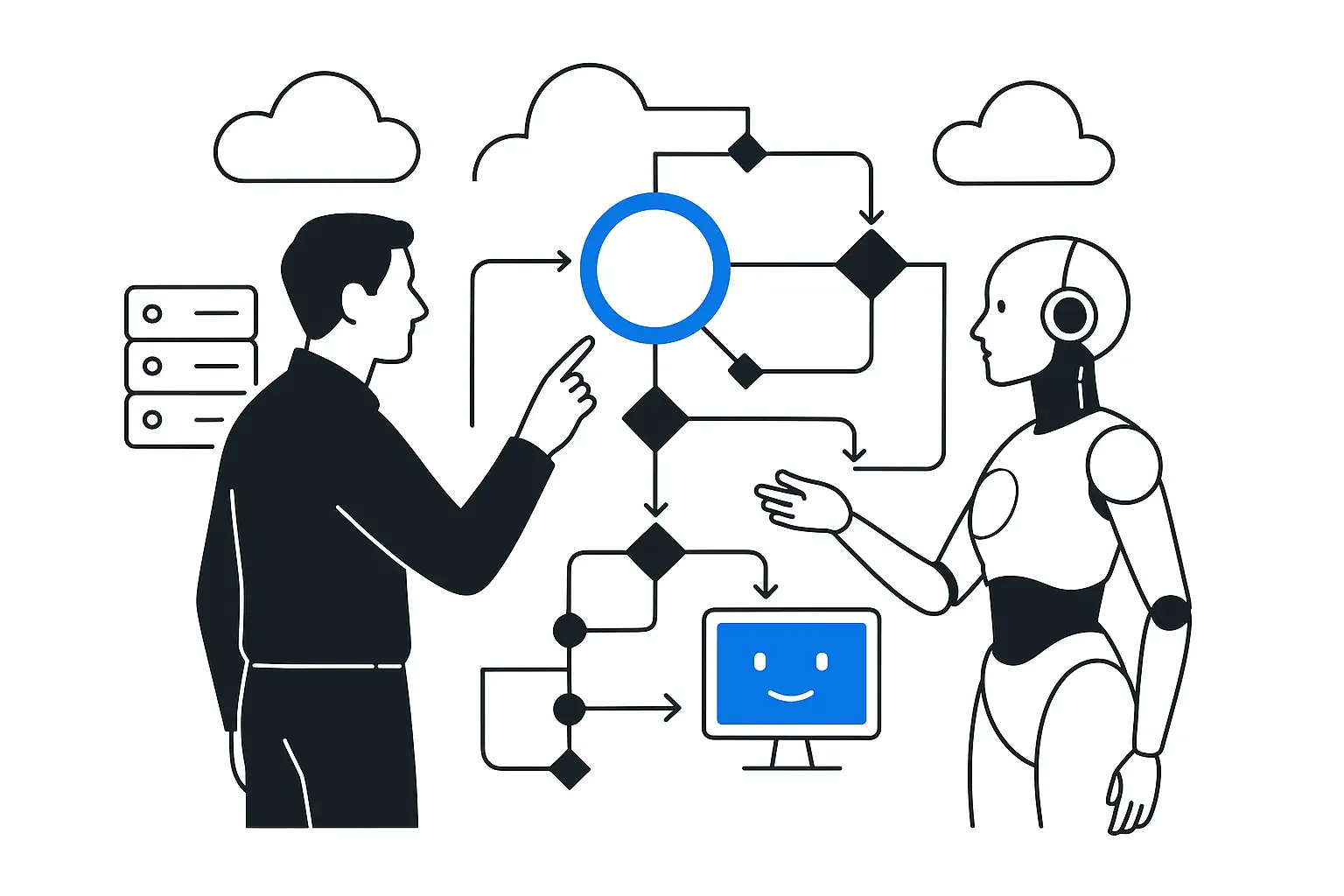
Within a company, the same logic is implemented by a gateway. In LLM & Security Gateway, we consolidate all model requests into a single entry point: 1. Classification.

The gateway determines whether a request contains personal data, bank details, or trade secrets. 2. Masking. Names, phone numbers, tax IDs, and account numbers are replaced with tokens before submission and restored in the response. 3. Routing.

A sensitive request is sent to a model within the controlled environment—Qwen on-prem or GigaChat.

An anonymized or public request goes to a powerful global model, such as Anthropic Claude. 4. Log.

The gateway records who sent the request, which model received it, and what data category it involved.

The auditor gets an answer in a minute, without an investigation.

Applications work with the gateway through a single API.

To change the model or routing rule, an engineer updates the configuration while the application code remains unchanged.

A new version of GigaChat or Qwen can be connected to this setup in one day.

Example: Contracts

In another piece, AWS describes a procurement director with hundreds or thousands of supplier contracts.

A chatbot can handle one PDF. Questions across the entire database, such as “which supplier do we spend the most on,”

, “which contracts expire this quarter” - it cannot answer: the data must first be extracted into a structured format. In a CIS company, contracts arrive via EDI and are recorded in 1C. The workflow looks like this. The EDI document goes to a local model because it contains details and personal data. The model extracts the amount, terms, parties, and signing status, then writes the fields to 1C or a data store. Analytical questions are answered from the table, while searches for clause wording use RAG.

If a complex legal analysis is needed, an external model performs it using only anonymized text. We have long built EDI integration with 1C and the bus for this type of flow; in this setup, the model is another process participant with its own access rights.

Verdict

In one month, AWS added new regions and another vendor's model to Bedrock. We expect this pace to continue. An architecture tied to one provider will need reworking with every such update. If the processing location and model choice are configured at the gateway, changing the catalog requires only a configuration update. A company that decides where data will be processed before the pilot removes the main risk of delaying production launch.

A company that postpones this decision pays for a pilot that then waits months for approval.

Source

Discuss the article: Where the Model Thinks: Why AWS Placed Claude…

Enter your email or phone number so we can get back to you.

Send via: