Gemini 4 Argon: The Best Model You Can't Use Yet

Argon leads 13 of 19 benchmarks but remains available only in a closed preview. Learn how to connect new models in a day, not a quarter.

  • What Google DeepMind released
  • Without access, TTU is undefined
  • Parity takes a week
  • How this is addressed technically

Trigger

  1. Google DeepMind introduced Gemini 4 Argon.

  2. This is Google's first model above the Flash class since February, when Gemini 3.1 Pro was released.

  3. According to the count Latent Space, Argon leads in 13 of 19 benchmarks we can trust. In experimental mode, the model produces up to one million tokens in a single response.

  4. It is currently available only in a closed preview for cybersecurity tasks.

  5. This leads to a rule for companies building processes on AI.

  6. The model becomes useful from the day it is connected to the production environment.

  7. Therefore, the architecture must allow a new model to be connected in one day.

What Google DeepMind released

In recent months, competitors released Fable- and Astra-class models, while Google responded only with Flash updates. Last month, Google DeepMind changed its leadership.

Argon was expected to close the gap, and it did so according to the benchmarks.

The main technical innovation is Long Decode Continuation. The model has two limits.

The context window determines how much text the model reads at once.

The output limit determines how much it writes in a single response.

Vendors have so far mainly expanded the context window

Argon raises the output limit to one million tokens, which Latent Space calls the first such case in the industry. One million tokens can hold an entire code module, a complete set of product catalog descriptions, or system documentation.

Google has not announced a date for open access and promises it will arrive “as soon as possible.”

Without access, TTU is undefined

At KT.Team, we evaluate tools by TTU (time to use): the time from a tool's release to the first result in a client's process. The model's closed preview has no public price, SLA, or data-processing terms approved by security. Therefore, it has no TTU.

A model like this cannot be connected to a revenue-critical process.

A score of 13 out of 19 shows what the model can do under laboratory conditions.

What matters to an executive is whether their metric will improve

For example, the share of product cards approved on the first attempt or the time required to close a request.

Google's benchmarks do not answer this question.

Running the model on the company's own tasks provides the answer.

Assess where AI can deliver impact in your process

Parity takes a week

OpenAI DevDay 2026 took place that same week

Latent Space analyzes, how OpenAI released a competitor to Jev in one week.

This is computer use: the model operates an interface like a person—opening windows, filling out forms, and clicking buttons.

Until recently, this technology was considered difficult. OpenAI replicated it in seven days, building on Sky Software, which it had acquired earlier.

For business, this means that a model's advantage is measured in weeks.

Over the past year, leadership has changed hands several times, and Argon continues the trend. A company that tightly couples its processes to one API faces two poor choices whenever the leader changes: rewrite the integration or stay with an outdated model.

How this is addressed technically

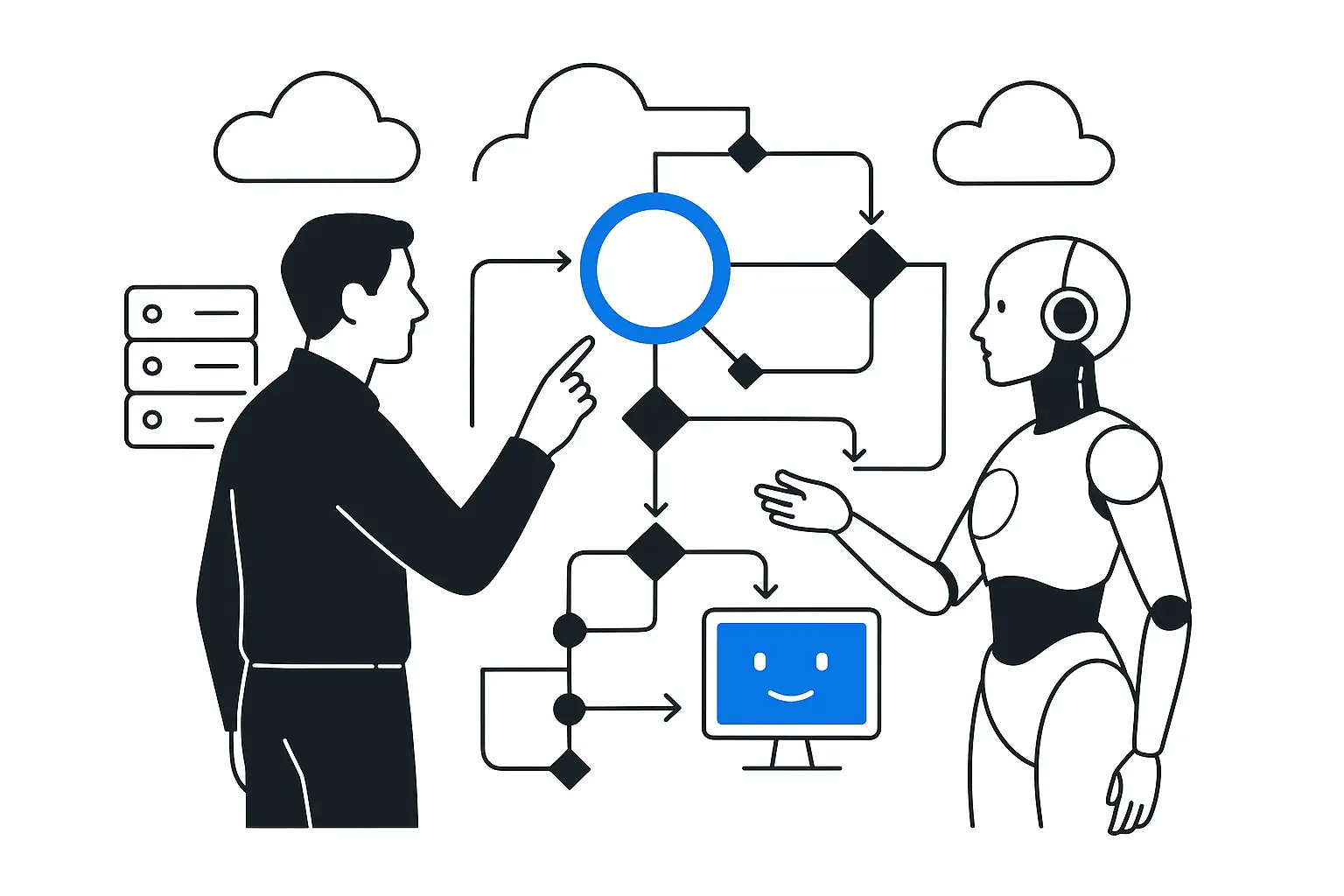
  1. Engineers place the model in a replaceable layer.

  2. The company's knowledge and processes remain in its own infrastructure and survive any vendor change. ### A gateway instead of direct calls

  3. All model requests go through a single point—in our case, the LLM & Security Gateway.

  4. The gateway routes requests between OpenAI, Anthropic Claude, Google Gemini, GigaChat, YandexGPT, and open models such as Qwen and Llama; masks personal data; and logs usage and quality.

  5. To switch to a new model, the team changes the gateway configuration.

  6. The process code remains unchanged. ### Tools through MCP

  7. The model's access to 1C, PIM, ERP, and databases is defined once through MCP.

  8. Any model that supports the protocol gets the same tools.

  9. The company's knowledge is stored separately in a RAG index, so it does not need to be moved when the model changes. ### Your own test suite

  10. A company needs its own reference set: 50–200 real tasks from its process with correct answers.

  11. When a new model is released, the team runs it against this set and sees within a day whether the metric has changed.

  12. The vendor's benchmark table shows an average result on someone else's tasks. ### Long outputs require oversight

  13. One million output tokens are useful where large volumes of repetitive text are needed: product descriptions and attributes for Pimcore or Akeneo, code migration, and documentation. In our PIM projects—product card text, taxonomy tagging, and filter facets—validation takes the most effort.

  14. Before publication, each generated product card is checked against the attribute schema and category tree.

  15. Without this validation, a long response becomes a mountain of text that no one reads and no one is accountable for.


Verdict

Argon is a strong model. We expect it to have a real advantage on tasks with long outputs, but this can only be verified once access opens. That day, companies with a gateway, MCP, and their own test suite will learn within 24 hours whether Argon improves their metrics and connect it without rewriting code. Others will study benchmark tables and schedule the integration for the next quarter. Businesses pay for results throughout the process, and the speed of connecting a new model is part of that result.

Discuss the article: Gemini 4 Argon: the best model you…

Enter your email or phone number so we can get back to you.

Send via: