Agent mode works in a loop
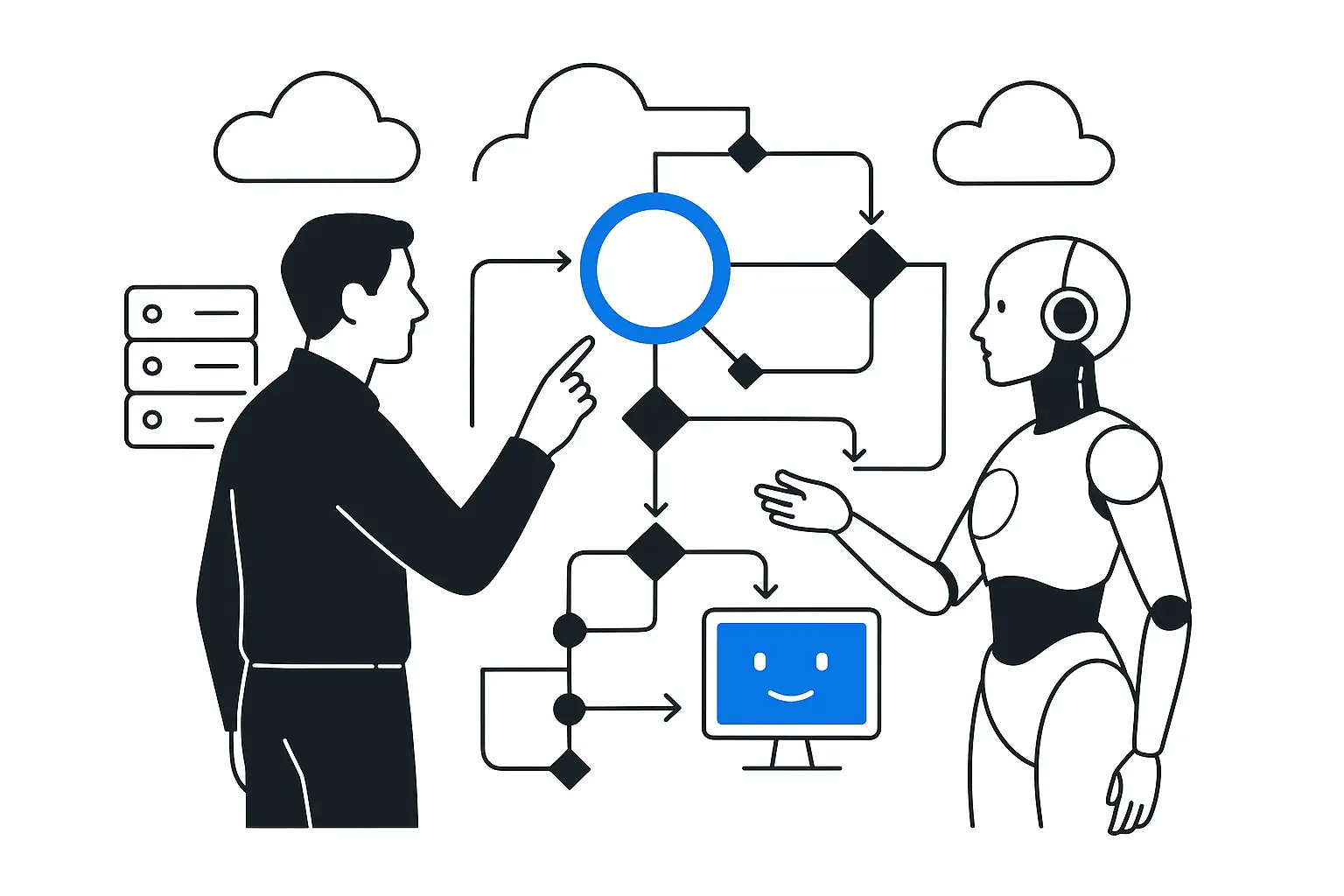
The model reads the task, selects a file, runs a terminal command, examines the failed test, fixes the code, and starts over.

Copilot now charges by tokens. Learn why agent step count matters more than model intelligence, and how managed settings and code indexing cut costs.
GitHub added OpenAI's GPT-6.1 Sol model to Copilot. GitHub bills for it at the provider's list price under consumption-based billing. In July, GitHub also released managed-settings.json and C++ codebase indexing. Together, these releases turn AI development into a production line with its own cost base. A company that does not calculate the cost of completing a task will learn it from the monthly bill.
GPT-6.1 Sol is available to all customers on Copilot Pro+, Max, Business, and Enterprise plans. GitHub offers it for agentic development and terminal work.
According to GitHub’s early tests, the model reliably completed tasks while using significantly fewer tokens and steps than models in the GPT-6 and GPT-5.6 families.
GitHub does not provide precise percentages, so companies will have to measure the effect on their own tasks themselves.
The key point in the release is the payment model: the model is billed according to the provider’s price list under usage-based billing.
Previously, expenses were capped by a fixed per-developer license fee; now there is no such ceiling.
The company pays for every token the agent consumes.
The model reads the task, selects a file, runs a terminal command, examines the failed test, fixes the code, and starts over.
On each iteration, it receives the accumulated context again: code, command output, and its reasoning history.
Therefore, task cost grows roughly as the number of steps multiplied by the context size. Consider a simplified example.
This is our own calculation; it does not use GitHub data.
The task takes 40 steps, and the model receives about 30,000 context tokens at each step.
A model that solves the same task in 25 steps saves about 40% of tokens and the same amount of waiting time. In a team of 30 developers who run the agent dozens of times a day, this difference will show up in the budget by the end of the first month.
This leads to a practical metric: the cost of one merged pull request.
It is easy to calculate, the CFO understands it, and it shows whether an expensive model justifies its cost.
This is TTU, or time to use: the time and money from launching an agent to code that works in production.
Starting July 1, managed-settings.json is available to all GitHub Enterprise Cloud customers.
The administrator centrally defines which models and plugins are allowed in VS Code and Copilot CLI.
Without such a policy, developers choose whichever model they prefer, usually the newest and most expensive one, and install any plugins they want.
A plugin with repository access can become a channel for code leakage, while the manager responsible may be someone who never saw the plugin.
CIS companies often cannot rely on Copilot, but they face the same control challenge. Their stack includes GigaChat, YandexGPT, Qwen, Claude, and proprietary models, which developers connect in whatever way they can.
At KT.Team, we address this with LLM & Security Gateway: a single point through which all model requests pass.
The gateway routes tasks by class: autocomplete goes to a low-cost model, while legacy refactoring goes to a more capable one.
It enforces team limits, masks secrets and personal data before sending them externally, and keeps an audit log.
Functionally, it is the equivalent of managed-settings.json for a heterogeneous stack, with traffic control added.
Copilot CLI can now index an entire C++ codebase. Microsoft C++ Language Server builds a persistent index of project symbols, including files that are not currently open.
Without an index, the agent searches from scratch for where a function is defined and who calls it on every request. In a repository with millions of lines, this takes dozens of steps, and the customer pays for each one.
The same problem exists in 1C configurations, Magento monoliths, and decade-old PHP systems.
MCP servers provide it with configuration structure, data schemas, and integration contracts. RAG over code and documentation supplies the required fragment, so the agent does not need to scan the entire repository.
In our experience with AI-native development, prepared context reduces the number of steps on such projects more than switching to the next model version.
This is a hypothesis: there is no universal benchmark for this yet.
- Introduce the metric “cost per merged PR”
and calculate it by team and model. -
Create an allowlist of models by task class and enforce it through managed-settings.json or a gateway. -
Give agents an index and context: language servers, MCP, and RAG over documentation. -
Set spending limits for each team with alerts when they are exceeded.
Each item looks simple, but works only with a mature process.
You need telemetry, a single access point for models, and engineers who can connect the token bill to production outcomes.
In three months, GitHub released everything needed for industrial AI development: usage-priced models, a central policy, and a code index. The more cost-effective model is the one that uses fewer steps per task. Companies that start measuring the cost of completed tasks now will save with GPT-6.1 Sol. Everyone else will have to explain the bill to the CFO without having the figures.