Inside-Out AI: Why Airbnb Starts In-House

Airbnb’s CTO, formerly on the Llama team, started in-house. Learn why building the team before the client saves AI budgets.

  • What Airbnb Does
  • Where companies go wrong
  • How inside-out works
  • What this looks like in a mid-sized business

Trigger

In January, Airbnb appointed Ahmad Al-Dahle as CTO. From 2023 to 2025, he led generative AI at Meta and brought the open Llama models to market. Latent Space describes his mission as “inside-out AI”: Airbnb first uses AI to accelerate its own development and only then brings the same capabilities to its guest product. In this approach, the order of steps affects the outcome more than the choice of model.

Most companies take the opposite path: they start with a customer-facing product and put the internal foundation off.

What Airbnb Does

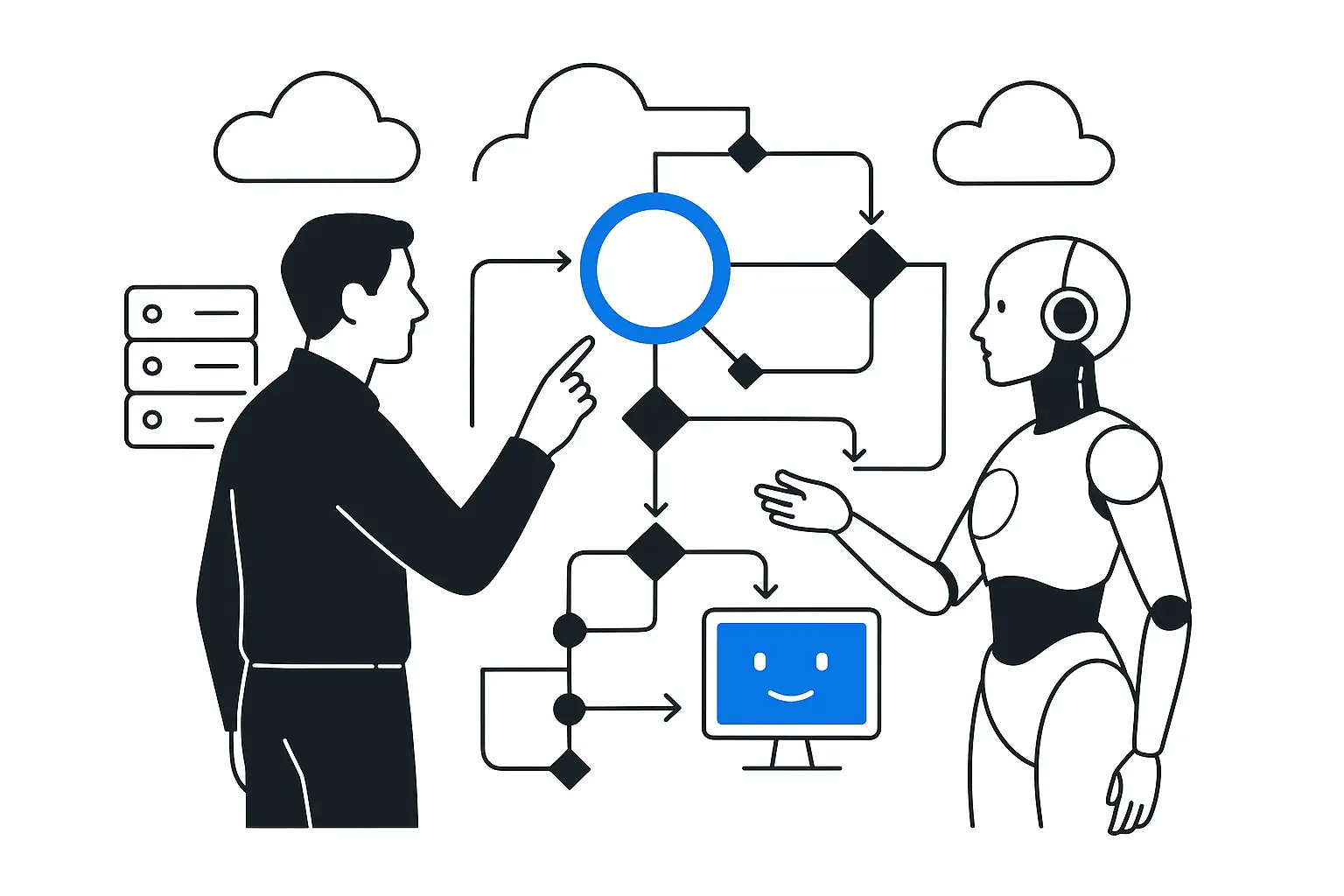
Airbnb set a goal of becoming an “AI-native company.” Al-Dahle breaks it down into two phases of work.

The first phase is internal: engineers and product teams get AI tools that shorten the path from idea to release.

The second phase is customer-facing: guests get new search, booking, and support experiences built on the same components. The Latent Space article mentions an internal tool called Everest.

According to the authors, Airbnb used it to accelerate the launch of a new product.

Guests never see Everest, but it determines how quickly the next feature reaches them.

The CTO appointment also signals the priorities

Airbnb hired a leader who had built foundation models and made its internal engineering platform his first assignment.

His experience with Llama is valuable because Al-Dahle knows how much infrastructure stands behind a single model response.

Where companies go wrong

In CIS business, an AI project often starts this way.

Management sees a demo, the team builds a website chatbot in a month, and the bot confidently answers the ten questions from the presentation but gets confused by the eleventh.

The model is usually not to blame

The bot has no access to current stock levels, prices, or order statuses; no one checks response quality or tracks the cost of each request.

An external pilot without an internal foundation tests only the interface. Data, integrations, and controls remain untested.

The customer is the first to notice a bot's mistake, and management shuts down the project before the team has time to find it.

The budget is spent, the metric has not moved, and getting the next AI project approved becomes harder.

Assess where AI can deliver impact in your process

How inside-out works

An employee forgives AI mistakes and reports them

An engineer whose assistant suggested an incorrect SQL query will fix it and post about it in the team channel.

A customer who receives an incorrect order-status update will most likely go to a competitor.

That is why the company tests AI with its employees while building three layers that the customer product will later need. ### Data layer

The model needs access to accounting systems, the catalog, and documents. At KT.Team, we connect 1C, PIM, and ERP to models in two ways.

The first is MCP, an open protocol that lets an LLM call functions in enterprise systems.

The second is RAG: the model answers using passages retrieved from the knowledge base.

If this setup already works in an internal manager assistant, the customer bot gets ready-made infrastructure. ### Control layer

Requests to the model pass through the LLM & Security Gateway.

The gateway masks personal data, blocks prompt injections, logs requests, and tracks spending by team.

Through it, the team switches between GigaChat, YandexGPT, Qwen, and Claude without rewriting applications.

Internal use cases give the gateway real traffic and usage data before external users connect to it. ###

The AI-native development process layer covers the engineering cycle between “code written” and “working in production”: test generation, reviews, documentation, and incident analysis. A team that has mastered this cycle ships customer-facing AI features faster because each one passes through a proven pipeline.

What this looks like in a mid-sized business

  1. Most of our clients cannot match Airbnb's scale, but the principle applies to any catalog.

  2. Consider a retailer with tens of thousands of products in Pimcore or Akeneo.

  3. The first phase is internal: the model drafts product pages, suggests filter facets, and assigns products to the taxonomy. The content manager edits the result and records manual exceptions for tags.

  4. We have delivered projects combining PIM and LLM, with the content manager having the final say. The second phase is customer-facing.

  5. The team connects the same facets and taxonomy to site search and collections, then uses the labeled catalog as the foundation for an AI advisor.

  6. The customer gets intelligent search even though there was no separate project for it: the team assembled it from the results of internal catalog work.

Verdict

  1. TTU, or time to use, is a useful measure: how long it takes from connecting AI to achieving the first measurable result.

  2. Inside the company, a mistake costs weeks of work and fixes; outside, it costs a customer and your reputation.

  3. My rule for executives: if AI has not made your own team faster within a quarter, it will not help your customers either. Airbnb hired the person who built Llama and first tasked him with accelerating its own development.

  4. Airbnb's sequence of steps is worth using as a guide when planning the AI budget for 2027.

Discuss the article: Inside-Out AI: Why Airbnb Starts With…

Enter your email or phone number so we can get back to you.

Send via: