On August 12, the Qwen team released Qwen3.8-2.4T-A95B, the first Qwen-Max-class model with open weights: 2.4 trillion parameters, 95 billion active per token, hybrid attention, and context of up to 262,000 tokens, expandable to one million. For businesses, the key point is not the parameter record but a change in the equation: previously, a model at this level could only be rented through an API; now it can be deployed on company infrastructure, keeping data in-house.
Qwen Releases Max-Level Weights: Business Impact
Alibaba released open weights for Qwen3.8-2.4T-A95B at Qwen-Max level, changing data control and infrastructure risk for businesses.
- Qwen Releases Max-Level Weights: Business Impact
- Renting a brain or owning one
- TTU matters more than model size
- Infrastructure ages faster than it seems
Renting a brain or owning one
-
A cloud API is convenient: no hardware is required, updates arrive automatically, and you pay by the token.
-
The price of convenience is that company data goes to the vendor, model behavior changes without warning, and pricing and availability depend on someone else's decisions.
-
For banks, the public sector, and any company subject to data-localization requirements, this is a concrete reason why some systems cannot operate through a foreign cloud API at all.
-
Open weights remove this concern: the model, data, and inference logic remain within the company's perimeter.
TTU matters more than model size
Open weights are a file. Deploying a model with 2.4 trillion parameters and a hybrid attention architecture is not a task for one engineer with one GPU. In its blog post about running Qwen3.8 on SageMaker HyperPod with vLLM, AWS shows how much engineering distributed inference requires: managing model checkpoints, distributing the KV cache across nodes, and allocating memory for hybrid attention. The model's final answer may appear in seconds, but that simplicity rests on a month of platform configuration.
That is TTU: the value of a tool is measured by how quickly it actually begins addressing a business need, not by the number of parameters it contains. A company that downloads the weights but does not build a platform around them is simply keeping a file on disk—it gets no result from it.
Map out your integration landscape
Infrastructure ages faster than it seems
That same month brought news explaining why platform work cannot be done once and then forgotten: TorchServe is officially unsupported, with no updates or security patches. Teams that deployed inference on TorchServe several years ago now carry the entire stack of risks themselves: selecting compatible PyTorch and CUDA versions and addressing vulnerabilities across every layer on their own. The lesson extends beyond Qwen: choosing an inference framework means supporting it for years after a project starts.
A self-hosting decision must account for operating the framework over many years—security patches and version compatibility—as seriously as its current capabilities.
Privacy as a mandatory pipeline stage
-
Self-hosting a model with corporate data immediately raises a question that the vendor partly handles in a cloud API: where the personal data is in the text and what the model does with it.
-
A recent study on PII detection presents a configurable detector that works with any LLM in Bedrock, evaluated on five public corpora against nine other detectors, including OpenAI's PrivacyFilter.
-
For a company bringing inference in-house for medical, financial, or HR data, PII detection becomes an automated pipeline stage for every request rather than a one-time manual check before launch.
-
This is a direct consequence of moving to open weights: responsibility previously held by the vendor now rests with the engineering team.
What to do about it technically
A practical setup looks like this: LLM & Security Gateway routes requests between a self-hosted model such as Qwen3.8 and external providers based on data sensitivity, with a mandatory PII-filtering layer at both input and output. RAG and MCP give the model access to current company data—orders in 1C, the catalog in Pimcore, and tickets—without fine-tuning or sending that data outside.
Qwen3.8's stated ability to perform multi-step coding and use tools autonomously makes this setup especially suitable for agentic scenarios: the model calls the required systems through MCP and manages a workflow instead of giving a one-off reply in chat.
Conclusion
Qwen-Max-level open weights shift the question from “which API is cheaper?” to “is the engineering team ready to run this model itself?” For a company without that readiness, a self-hosted 2.4-trillion-parameter model becomes an obligation: maintenance, patches, and privacy controls throughout the framework's lifecycle. Value is determined by the journey from a weights file to production: what it cost the engineering team and what that work actually delivered for the business.
Discuss the article: Qwen releases Max-level weights: what…
Related Cases

OSNO-VA: AI accountant
- Built an AI platform
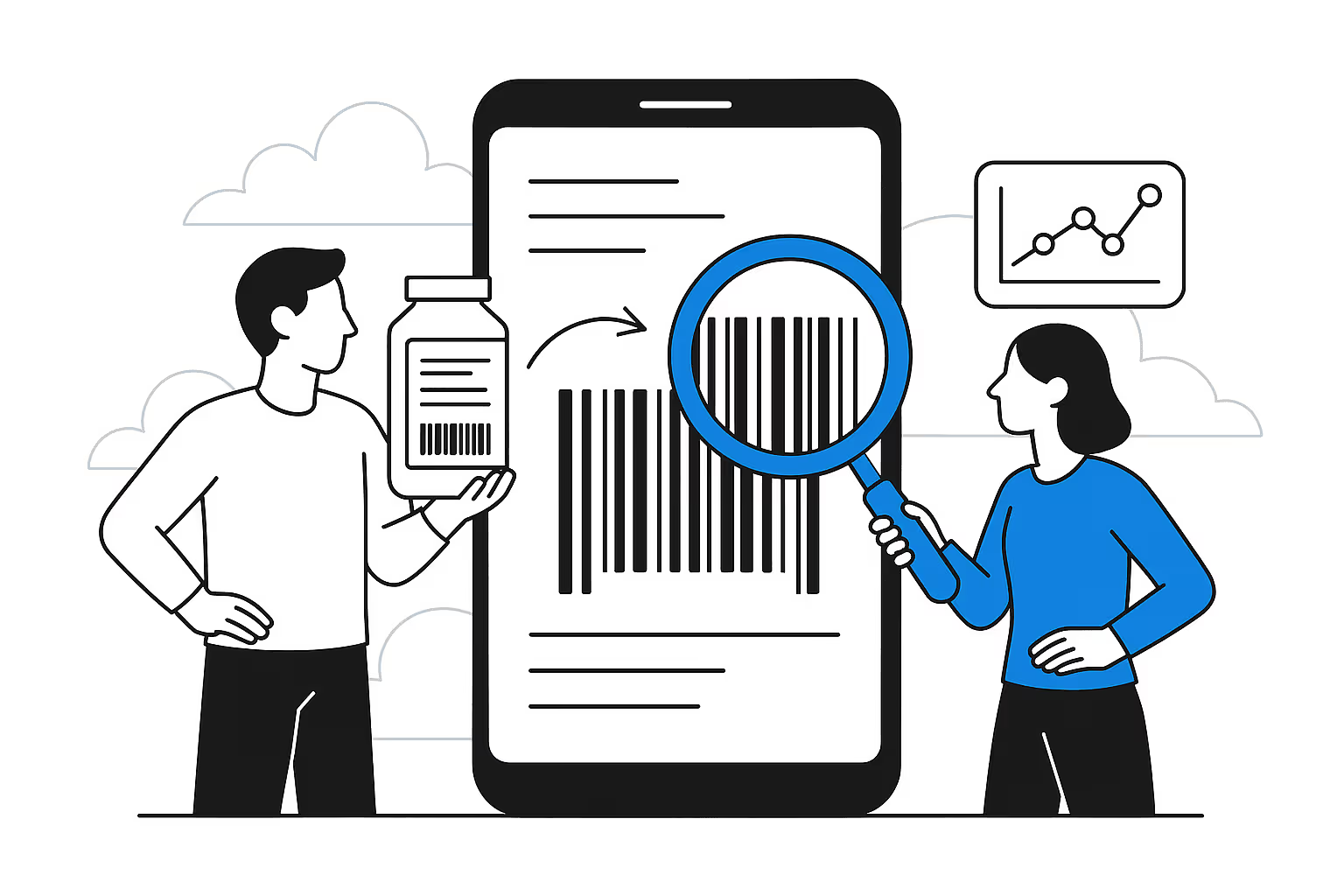
AI ingredient recognition by barcode
- The AI service processes up to 10 images in 2 minutes
- Recognition accuracy for composition is 80-95%