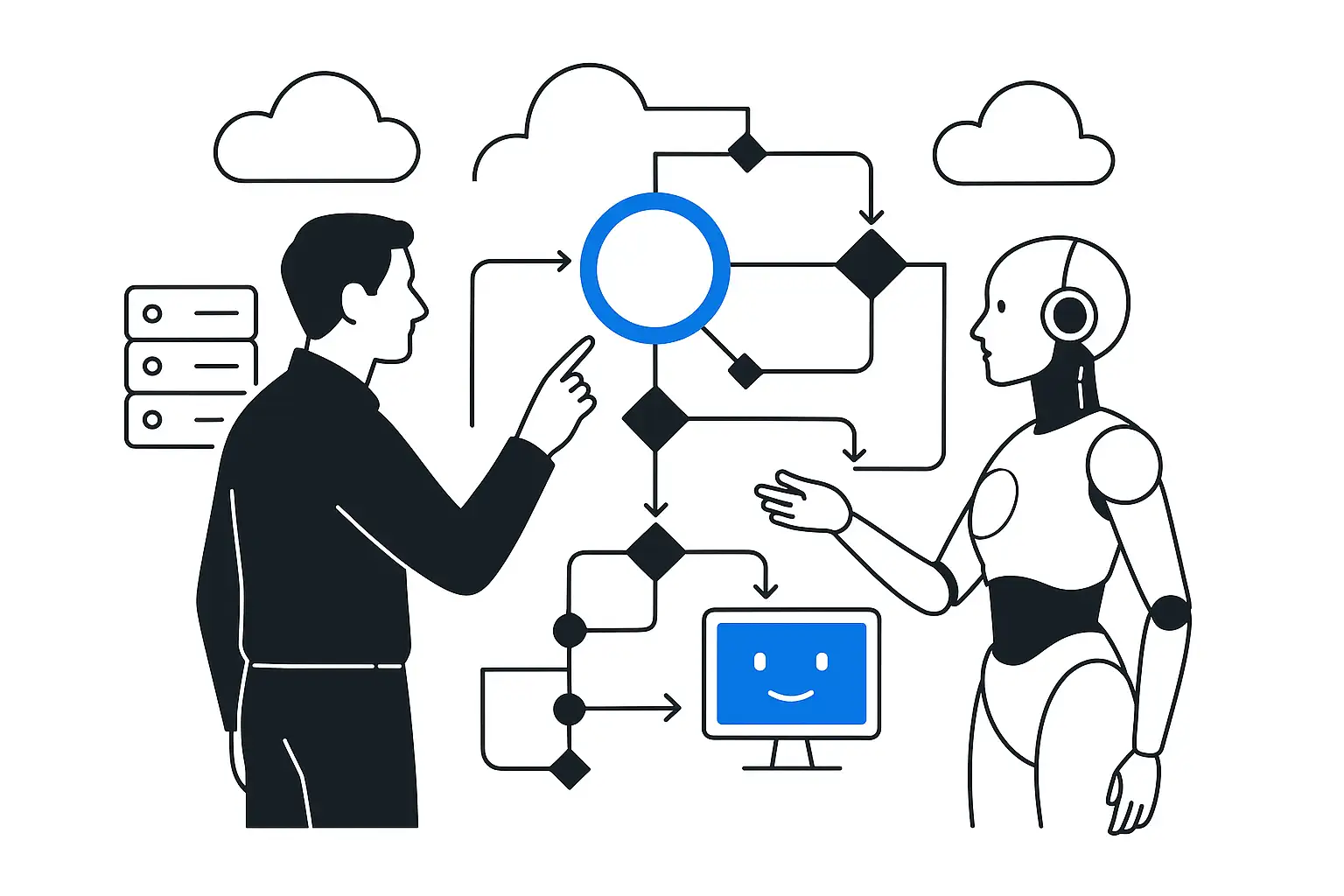
Loop engineering answers not “what can the agent do?” but “how does one cycle of its work proceed?”:
- what context it receives as input
- where the result is checked
- where the error goes
- who will see it

AI Engineer World's Fair 2026 recap: agent autonomy gives way to reliability engineering—skills, loops, and ontologies. What this means for business.
AI Engineer World's Fair 2026 captured a shift across the entire industry.
The organizers identified five trends that defined the year in agentic engineering.
The main shift is from raw agent autonomy to reliability discipline: loop engineering (execution loops), coding agents replacing traditional IDEs, and skills—packaged, reusable capabilities—as the new standard for agent functionality.
At the same time, engineers returned to ontologies—structured descriptions of a domain that keep a probabilistic model within deterministic boundaries.
A year ago, the industry competed to give models more freedom to act. In 2026, it is competing to complete tasks faster and more reliably.
The business conclusion is direct: an agent that promises to “do everything itself” is expensive and unpredictable; an agent with a narrow loop, a specific skill, and an ontology as input solves the task without disrupting the surrounding process.
Companies that deployed “fully autonomous” agents in 2024–2025 encountered the same problem: the agent could indeed write code, compile a report, or process a request—but unpredictably, with untraceable logic and no guarantee of repeatable results. Debugging such an agent took longer than the manual work it was meant to replace.
The TTU metric—time to use, the time until a tool actually delivers a result—went negative for such projects: the more autonomous the agent, the longer the team spent taming it.
Loop engineering answers not “what can the agent do?” but “how does one cycle of its work proceed?”:
An example of discipline: Matt's /wayfinder skill
Pokoka (Total TypeScript): instead of requiring the agent to create a complete plan in advance, the skill manages context between sessions, maintaining direction in projects without a clearly defined endpoint.
In this model, skills are the delivery unit:
A simple skill interface on the outside is the result of demanding engineering inside: edge-case testing, versioning, and rollback on failure.
The second layer of protection is the return of ontologies: structured domain schemas from the Semantic Web era, when they were used for web markup.
Agentic systems engineers use the same schemas to keep probabilistic models within deterministic boundaries: the ontology explicitly describes which entities exist, how they are related, and what the agent is allowed to do with them.
Without it, an agent infers relationships between data probabilistically; with it, the agent checks the schema and refuses any action the schema does not permit.
For business, it is the difference between an agent that sometimes invents a nonexistent CRM field and one that is technically unable to do so.
In AI-native development and AI-native integration projects, we apply the same logic. MCP defines the invocation contract between the agent and the tool: fixed parameters and types instead of a text prompt that the agent interprets in its own way. Our RAG operates on top of a domain ontology, searching across annotated entities and relationships. LLM & Security Gateway is the point where every model call is checked, regardless of which agent made it.
In projects for 1C, Bitrix, and Pimcore, the execution loop is agreed in advance: every agent step is subject to defined checks before work begins, rather than being added during incident analysis. This infrastructure is invisible from the outside, but it is what separates a pilot that works once in a demo from a system that handles production workloads for months.
Agent autonomy is a poor sales metric.
A good metric is the time to the first verifiable result and the stability of that result on the hundredth run.
Loop engineering, skills as a delivery unit, and ontologies as constraints are three specific solutions to one problem: turning a probabilistic model into a tool that can be trusted in production.
A simple output—as usual—is the hardest part of the work.