Query
Height, load, site, address, period, and site constraints.

Learn how to connect CRM, ERP, fleet, logistics, SLAs, and margin to automate equipment selection, quotes, and pilot validation on live requests.
Process map
The agent links site parameters, suitable equipment, fleet availability, logistics, service, and pricing authority. The manager confirms the result before it is sent to the customer.
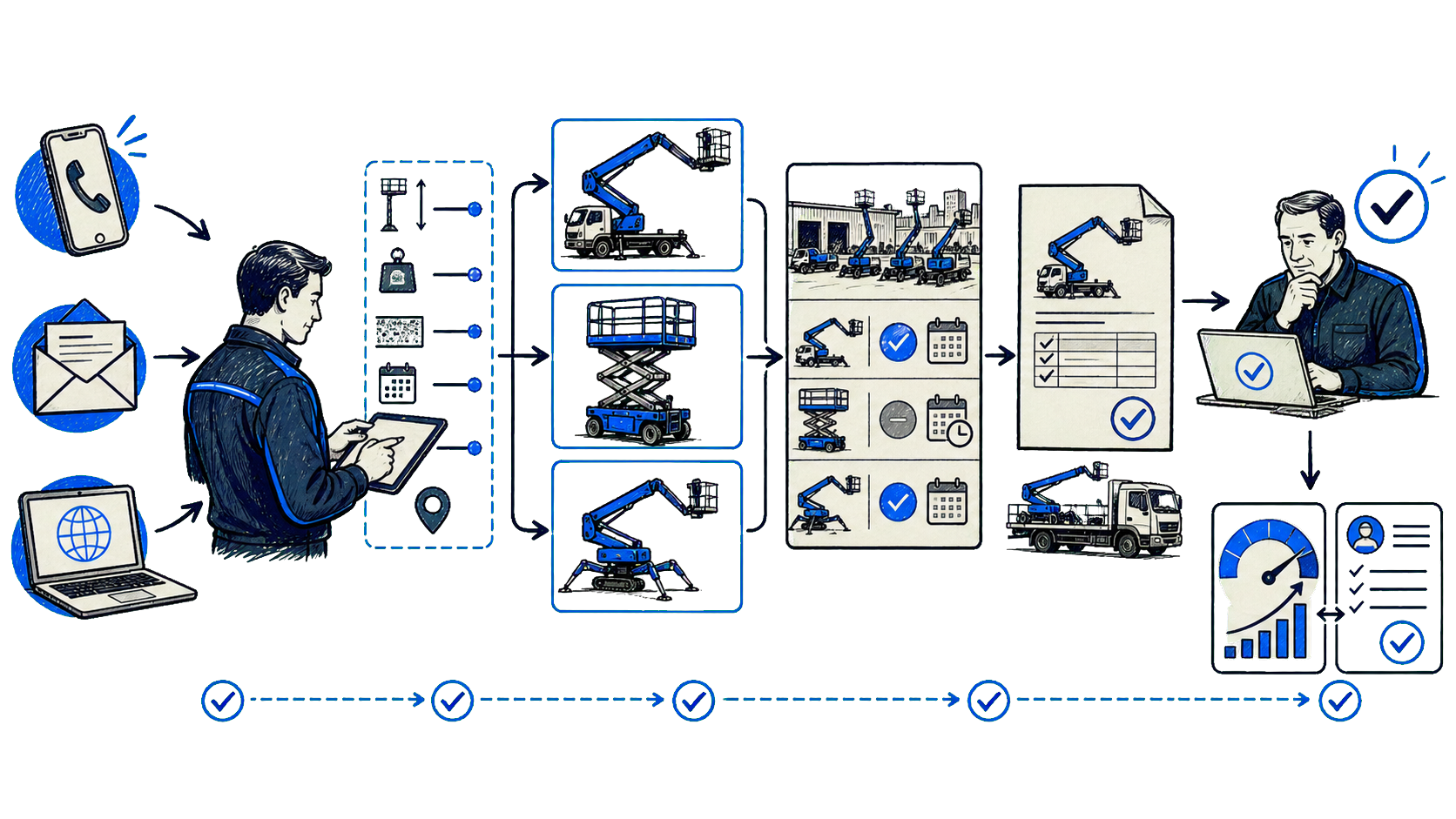
Height, load, site, address, period, and site constraints.
Allowed models, equivalents, and technical exceptions.
Availability, return, delivery, documents, and service window.
Price, margin, discount, confirmation, and result logging.
A request for a lift, loader, generator, or other equipment rarely includes all the data needed for pricing. The manager clarifies height and load, site conditions, surface, access, period, address, shifts, and noise or emissions limits. Then they check model fit, availability, planned return, repairs, delivery, documents, and price.
Each source updates at its own pace. CRM knows the customer history. 1C or ERP stores contracts and prices. Fleet tracking shows machine status. Logistics confirms the delivery window. Service knows about repairs and replacements. If these decisions are assembled manually, a fast answer can easily turn into a promise the operating process cannot fulfill.
The cost of an error has several parts: urgent replacement, an extra trip, customer downtime, a compensating discount, and expert time for repeated selection. That is why the target unit of automation is an executable commercial proposal with verified sources and an accountable manager. This setup is built around the manager's workstation: AI agent for the sales team receives the request, checks applicability, and prepares the quote, while the decision remains with a person.
Fragmented process
Managed process
Agent checked
Option A fits the site requirements and is available for the full period. Option B is technically suitable, but its readiness depends on return and inspection.
Suggested action
Send option A; show option B as an alternative, subject to availability after return
After confirmation: CRM + quote draft + logistics task · awaiting manager approval
Trace: site parameters + catalog + fleet + repairs + logistics + contract + rules version
Typical profitable requests follow the standard path. Expensive exceptions are routed immediately to an expert and separate approval.
Availability, return, delivery, documents, replacement, and service window become verifiable fields in the offer.
The discount is tied to the term, volume, prepayment, fleet utilization, and role authority. Deviations are escalated.
A recurring request is a hypothesis to test: it may point to equipment sales, a service contract, a new category, or a bundled offer.
| Practice | Open example | What can be transferred into your environment |
|---|---|---|
| One customer promise | Ashtead: managers see availability and price in real time, while automated processes connect sales, logistics, and service | Confirm requirements fit, availability, and delivery before sending the offer |
| Digital rental cycle | United Rentals: ordering, delivery status, service requests, off-rent, payment, and telematics are available in one digital environment | Design the journey from request to return and invoice as one event set |
| Dynamic Pricing Solutions | ERA / KPMG: Zeppelin Rental takes into account demand, fleet utilization, seasonality, and location | Start with recommendations and authority boundaries; enable autonomous pricing only after data validation |
| Complexity reduction | ITW applies an 80/20 front-to-back approach to serve profitable customers and reduce the cost of the complex long tail | Separate the standard flow from expert exceptions before automation |
| Service as a resilient model | Atlas Copco reports that service accounts for 38% of group revenue | Check whether service, substitution, and support can become part of a commercial product |
| AI in adjacent processes | ERA / KPMG: Loxam links a reduction in DSO to releasing nearly €20 million | Look for impact in receivables, fleet utilization, and repeat sales |
The metrics belong to the named companies and describe their context. They are benchmarks for choosing an approach, not a forecast of another business's results.
| Option | When it fits | Main constraint |
|---|---|---|
| Off-the-shelf CPQ or CRM module | The catalog is standardized, the configuration is stable, and availability and price are available through standard integrations | Returns, repairs, and technical rental exceptions may remain outside the model |
| Tuning the current environment | CRM, 1C or ERP, and fleet tracking are already in place; what is needed is an agent layer, rules, API, and a single workspace | The result depends on the quality of master data, events, and data owners |
| Custom service | The selection algorithm, pricing, or service promise is part of the company's competitive model | Higher total cost of ownership; requires in-house product decisions, testing, and operational ownership |
The options are compared using the same criteria:
The agent works on top of master systems and writes the result back
Channels
Master data
AI commercial engineer
Control
Action
The baseline timeline applies if request history, fleet data, and process owners are available. The suggested starting volume is 30-50 requests; the timeline and sample are confirmed after the assessment. Capture the decision path, manual hours, conversion, margin, and loss reasons.
Define required fields, approved substitutes, service promise, pricing authority, and escalation scenarios.
Run historical requests through the prototype and compare matching, promise, price, explainability, and errors against expert decisions.
Choose the architecture, calculate the impact and total cost of ownership, define the work plan and acceptance criteria, and decide whether to launch.
Pilot review
30-50 requests
The suggested starting volume is 30-50 requests. With them, you can test technical matching, service promise, margin rules, and integration boundaries. The result will be a justified decision on launching the pilot and assessing it.
FAQ
Yes, if the catalog, configuration rules, and prices are already standardized and availability and lead-time data are accessible through integrations. Before choosing a platform, check whether it covers returns, repairs, logistics, and technical rental exceptions.
In the pilot, the offer remains a draft. The manager confirms the equipment, the promise, and the price. Automatic sending should be considered only for a narrow standard segment after enough error statistics have been collected.
We recommend starting with 30-50 diverse requests and aggregated CRM, 1C or ERP, and fleet data for the last 3-6 months. The exact scope is confirmed after diagnosis. The sample should include typical requests, rare exceptions, and lost deals.
The system is designed around the principle of least privilege: separate read and write access, masking of unnecessary fields, request logging, rule versioning, and blocking actions that change price, equipment, or obligations without the required approval.
A verifiable answer to five questions: where the impact comes from, which data is sufficient, which implementation option fits, what risks remain, and which KPIs determine pilot approval.
Verification date: 12.08.2026