Don't Buy a Platform: AI-SDLC on a Ready Stack

AI-SDLC on a ready-made stack without a vendor platform: process owners ship prod through a git-native registry, prompt log, and light reversible gate.

  • AI-SDLC 2026: ready-made stack instead of a vendor platform
  • Thesis: don't buy a platform - build a thin one and own it
  • Foundation 1: a git repository with a registry of all repositories
  • Foundation 2: the owner speaks - and it reaches prod

AI-SDLC 2026: ready-made stack instead of a vendor platform

  1. The winning AI-SDLC for mid-sized and large businesses in 2026 is not another vendor builder platform, but a git-native stack assembled from off-the-shelf tools, where the process owner talks to Claude Code or Codex and changes prod.

  2. Exactly three things stand between it and prod: a git repository with a registry, a git-native prompt log, and a light automatic gate.

  3. Between the process owner and prod there is neither a human gatekeeper nor a proprietary platform - only an automatic reversible gate.

  4. We test this on ourselves: this site is edited by an AI agent on top of the repository, and every prompt is written to prompts/log.jsonl next to the change.
75%knowledge workers already use AI at work (Work Trend Index, May 2024)
78%bring their own AI tools - BYOAI, outside IT control

Thesis: don't buy a platform - build a thin one and own it

A vendor builder platform promises an all-in-one solution, but in practice it creates three problems: lock-in to the vendor, a queue to IT for every change, and gates that the process owner starts working around.

The answer is not "no platform," but the thinnest platform you build yourself and own.

It is assembled from commodity off-the-shelf tools and wins because it is more convenient than the workaround.

Be clear about the stack: git and CI are open, and MCP is an open protocol for exchanging context between agents and systems.

Claude Code and Codex engines are proprietary paid clients that you rent and can replace with another at any time.

The advantage is not that everything is open source, but that there is no bespoke platform you cannot leave.

Thin does not mean "none"

It has a contract: mutable data is read and changed through an agent-readable CLI with plan/apply/verify, the shared production workflow follows one path, the service has its own account, and data access goes through MCP with minimal privileges rather than a direct database connection.

This is the same engineering foundation as our service AI-native development; here we are not dissecting a service, but how to assemble the setup itself and why it wins.

Foundation 1: a git repository with a registry of all repositories

First foundation - the map

The registry lists all repositories in the setup:

  • skills
  • agents
  • services
  • servers
  • boilerplate
  • change recommendations

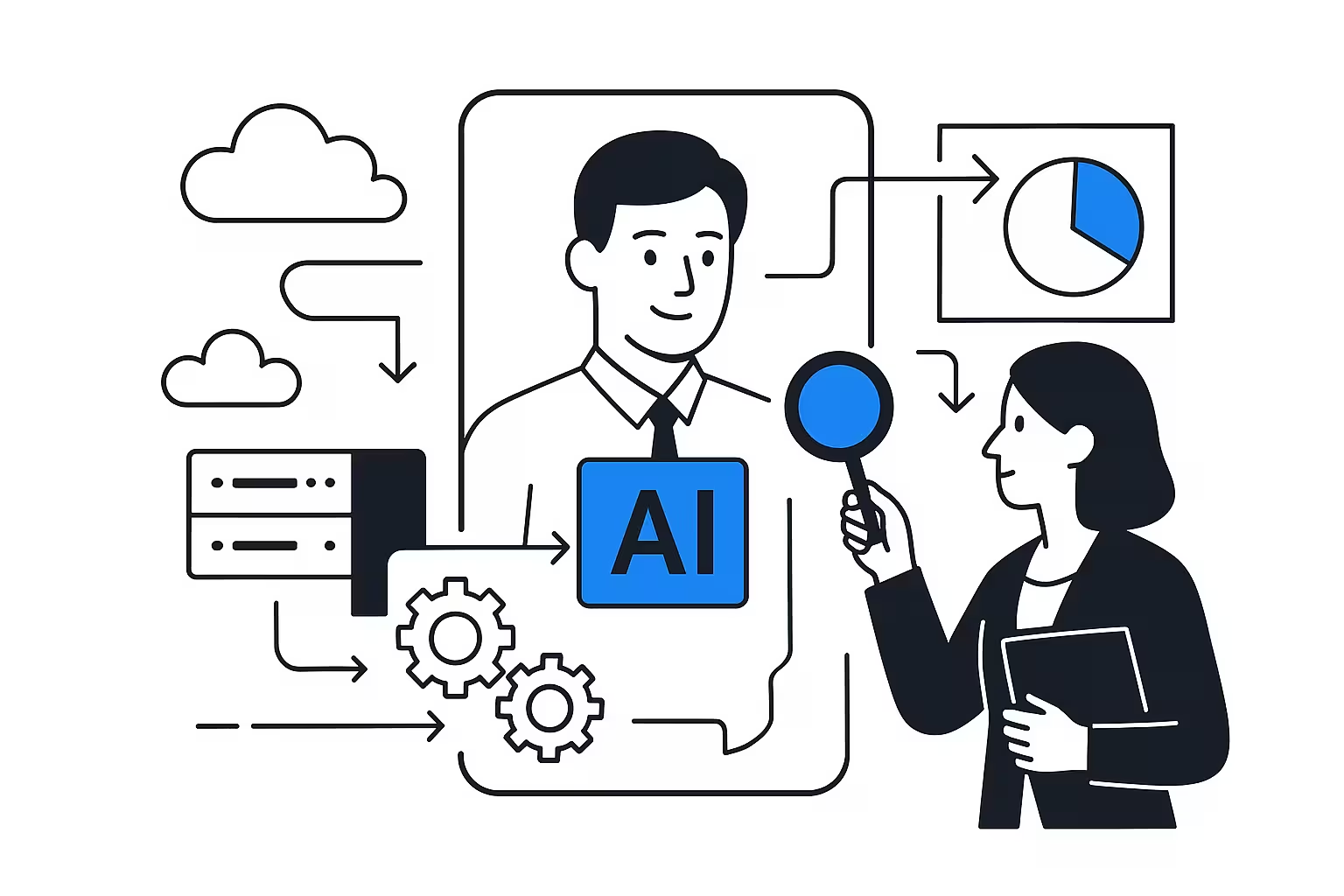
It is equally readable by a human and an AI agent: the agent can use the registry to understand where the needed process lives, which skill changes it, and where to write the result. We keep such a registry ourselves.

Our power-user boilerplate is REGISTRY.md as a single artifact catalog and a mirrored structure of skills, agents, and servers subgroups that matches the GitLab group.

By default, a new service is created as a shared platform: it is deployed from a shared path, not from one developer's home directory, and other authorized agents access it through a shared authenticated setup without transferring secrets.

The registry answers the question "what changes and where."

Who has the right to change prod independently, and at what maturity level, is a separate topic; we cover it in the article about Developer and PM levels L10-L60.

Foundation 2: the owner speaks - and it reaches prod

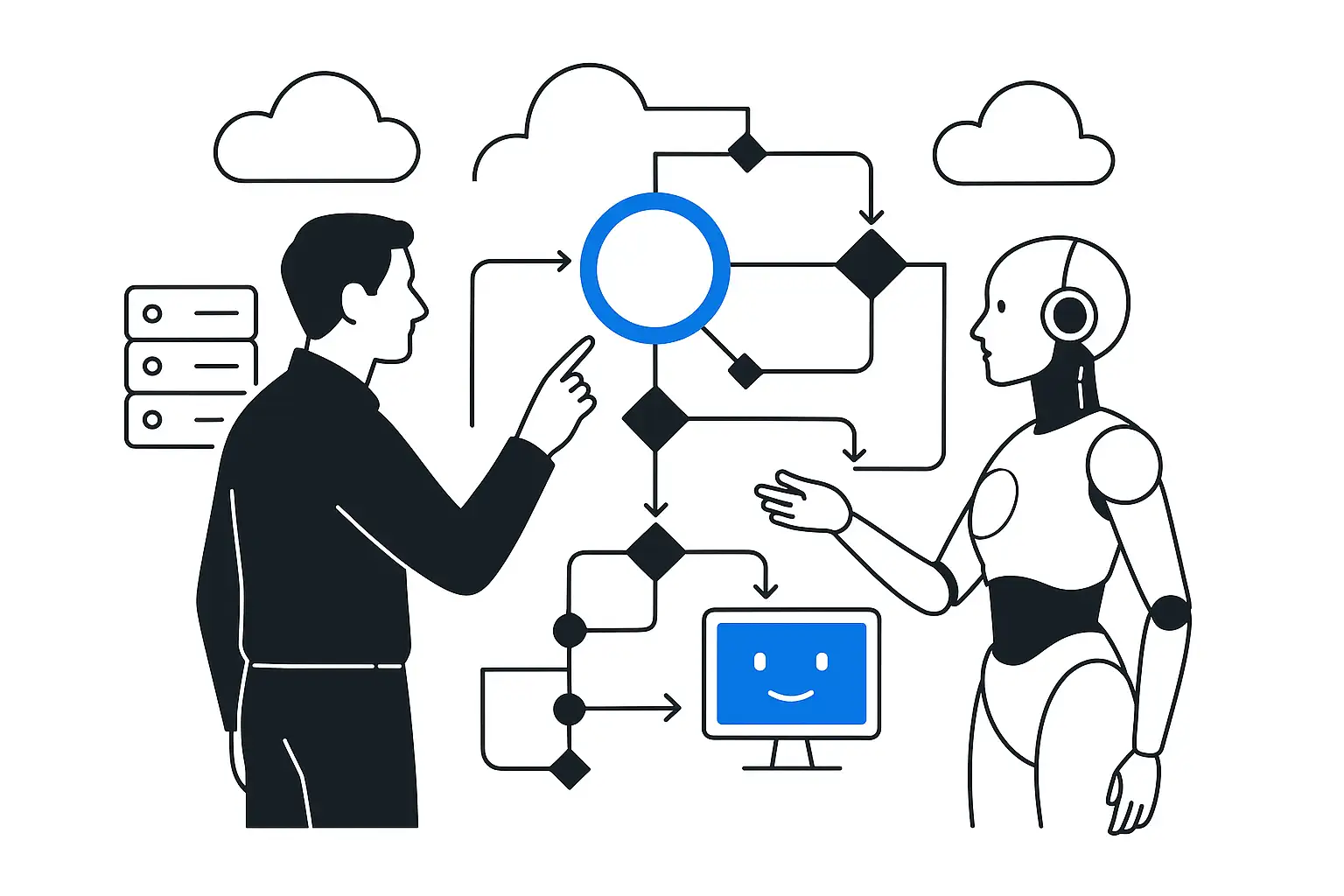
From the owner's conversation to prod

Owner

Process ownerStates the task in words

Engine

Claude Code / Codexready-to-rent client, replaceable

Context

Repository registrywhere the process lives and what changes it

Change

Plan + diffthe prompt is written to prompts/log.jsonl

Verification

Light gateTests and validators without humans

Deployment

apply -> verify -> prodobservability in place
  • low risk automatic gate pass, the change goes to prod
  • large blast radius human review is brought in
  • rollback git revert returns prod to its previous state
Between the owner and prod there is no human gatekeeper and no proprietary platform - only a registry, a prompt log, and an automatic reversible gate. The log and observability feed back to the owner.

Foundation 3: all prompts are logged git-native, without a central database

The third pillar is traceability

Every prod change is made from a prompt, and that prompt is stored alongside the change, in the repository itself, without a separate database or external service.

This gives every change provenance: you can see which request produced which diff.

The key word is provenance, not audit.

The log file is edited with a normal commit, just like any other file: our own log was once deleted and added back again.

It provides traceability and a record source, but not a tamper-proof audit trail.

Full audit means branch protection, commit signing (git commit -S), and a CI record requirement; the log file is the pragmatic first layer beneath them. And this is a young convention recently adopted by us, not a system battle-tested for years.

Three mechanisms and what happens to them during squash and rebase

Commit trailers

The Prompt: ... line in the commit body is visible and grep-able, but fragile: squash during merge eats the bodies of intermediate commits. Our auto-commits Deploy... are exactly this case.

File prompts/log.jsonl

Append-only JSONL next to the code. Survives any squash and rebase, and is readable by both humans and agents. This is the recommended record source.

git notes

Notes survive rebase, but by default they are invisible and not pushed. Durable, but easy to lose track of.

Assess where AI can deliver impact in your process

Light gate: why it does not contradict the principle

  1. The gate sits between the owner and prod - how does that fit with "no gatekeepers"?

  2. ? The answer is simple: a gate is not a person saying yes.

  3. This is an automatic proof of change safety: plan/apply/verify, tests, and validators run on their own.

  4. A human steps in only for changes with a large blast radius, not for every edit.

  5. The gate is fast, split by domain, and reversible: if something goes wrong, git-revert brings prod back.

  6. Here our own experience is the strongest argument, and it is an honest one.

  7. Our first gate was monolithic: one shared check for everything, and any validator error - even in an unrelated area - froze publication of the entire site.

  8. Such a centralized gate ties owners together and itself drives shadow AI: it is easier to work around than to wait.

  9. So the right move is not a bigger central gate, but domain gates split by risk.

  10. Even we are moving away from a monolithic gate to a distributed one.

  11. One rule: the sanctioned path must be more convenient than the workaround.

Vendor platform vs git-native stack

CriterionVendor platformGit-native setup on a ready-made stack
Ownership and lock-inData and logic are locked inside the vendor's productEverything in your git, engine replaceable
Owner edit speedThrough a queue to IT or the vendorThe owner changes prod independently within their maturity level
TransparencyLogs stay inside the platform, export is limitedEvery prompt and diff lives in the repository
Shadow AI riskHigh: friction drives people undergroundBelow: the sanctioned path is more convenient than the workaround
CostLicense plus lock-in, all-inclusive on paperTradeoff: Claude/Codex seats plus engineering ownership and maintenance of the registry, gate, MCP, and validators. Cheaper in terms of lock-in, not effort
Who is responsible for the resultVendor owns the platform, you own the outcomeYou own the setup and the outcome
IntegrationsProprietary connectorsMCP as an open protocol
GateOften monolithic and shared by everyoneSplit by domain and risk, reversible

Antithesis: a heavy centralized setup = shadow AI

What KT.Team does

We build these setups and use them ourselves

OSNO-VA is our AI product for accounting: management reporting with MCP access for people and agents, automatic posting of source documents in 1C (from invoice photo to journal entry), and corporate project memory in GIT.

This is living proof of the MCP plus git-native memory combination, not a slide.

We moved the financial logic out of fragile spreadsheets into SQL and executable skills that the agent accesses through MCP.

The context layer is sloy-KT: chats, meetings, files, tasks, and finances become machine-readable context in GIT, split by project.

The registry and structure are our power-user boilerplate with REGISTRY.md. And this site is that same setup in action: it is edited by an AI agent on top of the repository, with the prompt log next to the changes.

We state the boundary honestly: the setup lets the process owner change prod themselves, but within their maturity level - the registry, agent, and light gate compensate for the gap, they do not remove it. AI without engineering fundamentals reduces stability, and DORA metrics show this directly, so a gate is needed, but a light one.

You can build the first working lever on a live task in 1-2 weeks, with payment due after the result is accepted.

Cases

AI setup cases

All cases

AI agent sprint

Let's build your first AI lever

Let's take one real process-owner task and build a working git-native setup for it: a registry, an agent, a prompt log, and a light gate. Payment is due after the result is accepted.

Break down the task in 30 minutes

Sources

Source check date: 07/18/2026. Microsoft and LinkedIn, "2024 Work Trend Index Annual Report: AI at Work Is Here. Now Comes the Hard Part" (May 8, 2024, survey of 31,000 people in 31 countries): 75% of knowledge workers use AI at work, and 78% of them bring their own AI tools (BYOAI) - microsoft.com/en-us/worklab/work-trend-index/ai-at-work-is-here-now-comes-the-hard-part

Discuss the article: Don't Buy a Platform: AI-SDLC on...

Send via: