OSNO-VA: AI accountant
- Built an AI platform
Which three trends are changing ERP in CIS: embedded AI, cloud and SaaS architectures, real-time analytics, and predictive scenarios.
80% ERP software in CIS is domestic origin. Vendors are actively adapting products to business needs: reducing integration complexity within the IT ecosystem, adding AI elements and predictive analytics, and advancing cloud technologies.
With CIS ERP, enterprise management becomes more transparent and accurate: analytical and predictive tools give businesses a strategic advantage in the digital economy.
By 2026, up to 40% of large enterprises will begin use embedded AI tools in their ERP systems for customization, forecasting, and automating routine tasks.
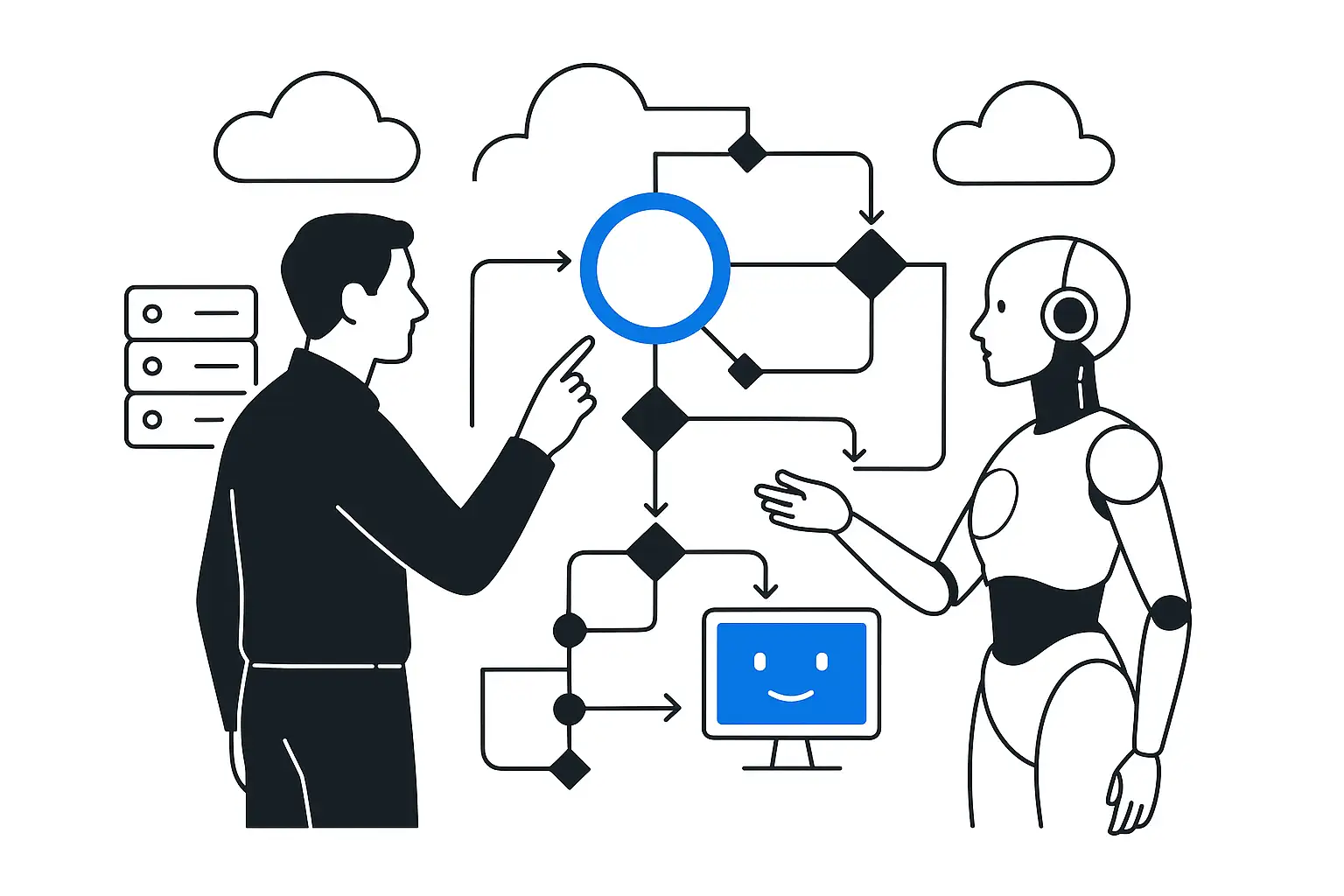
CIS vendors have already launched: - An ML-based sales forecasting service in "1C". - The "1C:Primary Document Recognition" feature, which analyzes scans/photos of invoices, delivery notes, and acts and automatically converts them into documents within the system. - The platform Napoleon OnPremAI - a local LLM system.
It searches for information in the corporate knowledge base, supports employees with automated responses, uses a multimodal knowledge base with text, audio, and images, and enforces access rights. LLM solutionsincreasethe performance of individual business processes by 20-50%.Implement intelligent searchbased on LLMs and ML models to reduce time spent on operations and focus on strategic tasks. How to embed LLM / AI / ML into ERP
| ERP scenario / module | AI / ML / LLM features | Advantages |
|---|---|---|
| Document processing / EDI / scan / recognition | Text recognition, document classification, automatic field filling, validation, and smart data extraction from contracts, delivery notes, and invoices | Less manual work and fewer errors, faster document processing, and lower data entry costs |
| Forecasting / planning | Production and procurement planning, forecasting demand and supply chain delays, and determining optimal inventory levels | Reduced losses from overstocking, improved planning accuracy and resource utilization quality |
| Decision support | Virtual AI assistants that answer questions in natural language | Faster access to information, less manual document analysis, and more effective management |
| Process automation | Letter and report template generation, recommendations for next steps in business processes, automatic production order and request population | Less time spent on routine tasks, fewer human errors, faster response to changes |
| User support / customer service | Chatbots and virtual assistants that process requests, provide instructions and FAQs, automatic request routing | Reduced load on support teams, faster ticket handling, more consistent answer quality |
| Risk assessment / quality control | Detection of anomalies, potential failures, fraud, and errors, plus risk analysis and natural-language descriptions | Improved assessment reliability, reduced losses from errors and risks |
Challenges and limitations 1. Data quality.AI requires clean, accurate, and historically complete data. If the data is poor, the model will train inefficiently. 2. Security and privacy.When processing personal data and trade secrets, it is important to comply with laws and standards so data is not leaked or used unlawfully. 3. Interpretability and trust.AI / ML / LLM are often a "black box".
For financial, legal, and management tasks, solutions must be explainable. Model errors can lead to reporting violations, lost contracts, and losses. 4. Implementation cost.Model development and adaptation, infrastructure, specialists, and maintenance require investment. To make models cost-effective, they need ongoing support and updates.
5. Regulation and standards. In CIS, the regulatory framework for AI is still being formed, but systems must comply with public procurement requirements, registries, and legislation.
6. Technical limitations: - model size and computing resources, especially given the need to process personal data locally; - response time: sometimes answers and forecasts are generated with delays, which is not suitable for real-time tasks; - integration with existing ERP architectures: it can be difficult to embed AI into legacy systems with complex customizations and different modules without refactoring and process changes.
What to consider when designing AI integration in ERP - Defining tasks and scenarios. Clearly define which ERP functions the model will improve, which actions will be automated, and which will remain manual. - Architecture selection: cloud, hybrid, or on-premises. If the data is sensitive, choose an on-premises solution. - Model / vendor selection. Decide whether you will implement ready-made LLM / ML modules or fine-tune models on your own data.
You can also use open-source models or collaborate with developers. - Methodology and quality standards. Define KPIs - accuracy, response time, fault tolerance - and run testing and monitoring. - Training and expertise. Hire Data Science, ML, NLP, and DevOps specialists who can adapt, fine-tune, and maintain the solutions. - Change management. Prepare users and business processes for change.
Introduce new interfaces and ways of working, provide corporate training. - Security and compliance. Ensure protection of data, APIs, and access rights, and legal compliance. The outlook for AI development in ERP - Standardization of approaches.
Methodologies will become more mature and becoming essential for large enterprise customers. - Multimodal systems. LLMs will continue to evolve to work not only with text, but also with images, audio, video, and cameras for recognizing voice commands and documents. - Embedding LLM-based assistants into ERP interfaces.
Chat assistants and prompts will automatically generate responses and help users work in the system. - Training models on industry-specific data. This will improve the accuracy and relevance of predictions, patterns, and automation. - Improved interfaces and UX. Users will be able to interact with ERP through natural language - commands, queries, and reports based on simple descriptions. - Widespread adoption. LLM functionality will become a standard ERP module, especially in large-scale solutions.
Simplified versions will appear for small and medium-sized businesses. - Greater focus on model explainability and transparency. This way, managers will understand why the system suggests one decision or another. - Reduced implementation time and cost. Templates, ready-made modules, and vendor plug-and-play solutions will help with this.
Cloud ERP - are ERP systems fully hosted in cloud infrastructure, public or private. Companies access them over the internet and save on hosting and maintaining physical infrastructure. SaaS-ERP - a type of cloud system. You you get ERP as a service, by subscription. The vendor maintains, updates, and ensures the system's availability and scalability. Hybrid ERP - a combination of on-premises and cloud components.
Some workloads and data are stored locally, while others are in the cloud. Business processes can run in the cloud or on-premises, depending on security requirements, speed, and latency sensitivity.
For example, analytics or BI applications are often hosted in the cloud, while speed- or security-critical functions remain on-premises. In 2024, revenue from CIS cloud infrastructure servicesamounted toRUB 165.6 billion, up 36.3% from the previous year. Why companies are turning to cloud ERP 1. Lower capital expenditures and faster deployment. The SaaS model reduces upfront costs and time to launch.
2. Flexibility and scalability. Resources can be easily scaled to match demand, modules can be accessed from different locations, and peak loads can be managed: seasonal sales, reporting periods. 3. Import substitution and localization. After sanctions and the exit of foreign vendors, companies prefer local cloud providers and SaaS offerings from domestic vendors.
This makes it easier to comply with legal requirements for data protection, storage, and processing within CIS. 4. Update and support speed. The cloud / SaaS approach makes it faster to receive updates, security patches, and new features without the lengthy installations and migrations typical of on-premises solutions.
5. Convenience for remote work and mobility. The cloud provides access from different locations and supports mobile users, distributed offices, and branches without investing in VPNs and hardware infrastructure. 6. Reduced technical complexity and operating costs. The solution provider ensures fault tolerance, backup, updates, scaling, and monitoring.
Risks and limitations 1. Security and legal compliance.Cloud providers must have the required certifications and comply with CIS security standards. In hybrid setups, it is harder to establish a unified security policy between the on-premises and cloud parts. 2. Reliability, fault tolerance, network availability.Cloud components depend on the internet connection, so outages or delays can be critical. Reliable service level agreements are required when integrating.
3. Integration with existing systems.Legacy on-premises systems, custom modules, and specialized integrations may not migrate well to the cloud. Code adaptation or refactoring may be required. 4. Cost management.Capital expenditures decrease, but operating costs for subscriptions, traffic, cloud storage, maintenance, and support may rise. It is important to assess long-term savings correctly. 5. Control over dependencies.Dependence on a cloud provider can become a bottleneck.
There is a risk of lock-in to a specific technology or cloud platform. Forecasts and growth areas - Expected, that by in 2028 the cloud services market in CIS will grow to RUB 463.8 billion. - Public cloud / SaaS / hybrid ERP solutions will become the standardfor small and medium-sized businesses.
Large enterprises will use hybrid models or private clouds. - Will continue to develop cloud BI and management modules, which are easy to connect and scale. - Providers that offer secure, certified clouds, those that comply with CIS law will gain a competitive advantage.
Real-time analytics - is the ability of a system to collect, process, and visualize data almost in real time, with minimal delay. It helps support operational decisions: monitoring production, logistics, and inventory, and responding quickly to events and deviations. Predictive analytics uses historical data and machine learning models to predict future events: demand, equipment load, failures, and customer churn.
Why interest in analytics is growing 1. Uncertainty in the external environment. Supply chain changes, price volatility, and logistics disruptions force companies to respond faster and forecast risks in advance. 2. Availability of data and technology. Many companies have already accumulated historical data on sales, production, and service. Advances in technology - big data, ML, and streaming processing - make data stream analysis possible.
3. Cloud / hybrid architectures. Clouds make it easy to scale computing capacity, run models, collect data from different sources, and aggregate it. 4. Higher demands for efficiency and cost reduction. Forecasting helps avoid overstocking, equipment downtime, fines, excess labor, and losses.
5. Regulatory and competitive requirements. Companies need to identify deviations and failures in time to avoid environmental, financial, and reputational risks. CIS case: the predictive analytics system "PRANA" Company ROTEK developed the PRANA system - "Predictive ANalytics" - to track and forecast the technical condition of equipment.
It operates in power and industrial infrastructure: CHP plants, gas and steam turbines. "PRANA" processes thousands of parameters in real time, stores historical data, builds benchmark models, and calculates deviations and alerts. At one generator facility, it reduced losses by almost 13.6x, reducing incidents. Promising predictive analytics technologies and methods
| Method / technology | Features | Use cases |
|---|---|---|
| Time series and forecasting methods | Forecast demand, production, resource consumption, and seasonal fluctuations | Trade, manufacturing, logistics |
| Machine learning / ML models | Failure forecasting, anomaly detection, event classification, and action recommendations | Industry, energy, maintenance, services |
| Streaming data processing / streaming systems | IoT sensor and equipment data collection and analysis in real time, instant alerts, parameter monitoring | Manufacturing, equipment, energy sector, infrastructure |
| Integration of ERP / MES / monitoring / IoT | Combining data from different sources: ERP, MES, equipment management systems, sensors, SCADA | Factories, enterprises, distributed production sites |
| Scenario modeling | Modeling variations: changes in demand, inventory, supply delays, disruptions, and the impact of seasonality or external factors | Planning, inventory and demand management, budgeting |
| Real-time monitoring dashboards | Visualization of KPIs, deviations, and warning signals | All enterprises, especially medium and large ones |
Challenges and barriers 1. Data quality and completeness. There may not be enough historical data, and existing data may be poor quality: incomplete, incorrect, or lacking time, event, or context references. For high-quality analytics, it is important to set up real-time data collection mechanisms. 2. Infrastructure and architecture. Data must arrive continuously, with minimal latency, and be transmitted and processed reliably.
This requires networks and compute resources, storage, streaming platforms, and processing tools that can handle the load. 3. Specialists and expertise. The team should include Data Science specialists, ML engineers, and analysts who can do more than build models and can integrate them into ERP business processes. They need skills in visualization, KPI management, and scenario configuration.
4. Process change and decision-making culture. Managers and employees must get used to decisions based on data and forecasts rather than intuition. They need to be ready to react quickly to warnings and deviations and adjust plans. 5. Costs and ROI. Initial investments in data collection, models, and integration can be high. To pay off, forecasts must be accurate and deliver savings or growth.
6. Security, privacy, legality. Working with personal data, equipment data, and financial metrics requires control, protection, and legal compliance. Real-time transfer can create leakage and interference risks if channels are not secured. What to consider when implementing analytics in ERP - Goals and metrics. Define in advance exactly what you want to forecast and why: demand, equipment failure, or logistics delays.
Decide which KPIs should improve and how to measure forecast accuracy. - Data Sources. Analyze which systems already exist - ERP, MES, CRM, IoT. Assess the volume and quality of data, the need for new sensors, data collection, and integrations. - Data processing and storage. Choose the right architecture - data warehouses, streaming platforms such as Apache Kafka, computing power. - Model selection.
Define the required type of forecasting models - ML/statistical, possibly hybrid. Train them on historical data, then test and validate them. - Integration into workflows. Define: - how signals and forecasts will be communicated to decision-makers; - how deviations and forecasts will be acted on; - who is responsible for adjusting plans. - Visualization interfaces.
Prepare user-friendly dashboards, monitoring panels, reports, and alerts so the information is clear and timely. - Support, training, and culture change. To help users trust forecasts, understand their limits, and know how to work with them, provide regular training. - Cost and business impact assessment. Run simulations of the effects and return on investment, comparing costs with the value gained. Evaluate cost reductions, less downtime, lower inventory, and increased revenue.
CIS ERP systems are becoming a full-fledged foundation for digital business management. The integration of AI, the adoption of predictive analytics, and the growth of cloud and SaaS models are changing how planning, accounting, and decision-making work. Companies that invest in making ERP more intelligent gain clear advantages: - reduce costs and time spent on routine work; - improve forecast and planning accuracy; - adapt faster to market changes; - increase controllability and process transparency.
Over the next 3-5 years, these technologies will become the standard. They should be adopted now to stay ahead rather than catch up.