There are no random people on our project team.
Everyone working on ERP implementation has passed selection, training, and practical certification on internal test environments.

We implement ERP by scope, so finance and inventory deliver value in months, not a year, with case studies, reviews, and a fixed price for the agreed result.
Our clients














We implement ERP for full control over key business processes, from planning and procurement to warehouse, production, sales, and finance management. A flexible architecture unifies data and operations in a single system, speeds up task execution, reduces operating costs, and minimizes errors through transparency and automation. You also get a business process audit to assess whether ERP implementation is right for you and to choose the optimal module configuration.
Sales, procurement, production, warehouse, and finance run in the first line, where management impact appears fastest.
Changes are isolated into separate modules and connectors, so the core architecture does not break during updates.
CRM, WMS, OMS, BI, accounting, and industry systems are connected through standard interfaces.
Everyone working on ERP implementation has passed selection, training, and practical certification on internal test environments.
We continuously update our expertise: architects, developers, and managers share cases so we do more than just follow instructions.
, and build it the way real business works.
What makes an ERP project scary is not the price, but its unpredictability: the budget grows along the way because no one fixed the scope at the start. We address that with a model, not a discount.
If the scope can be fixed, we work at a fixed price for an agreed outcome, not an hourly rate - in that case, we carry the scope risk. The stage boundaries and acceptance criteria are defined before development, together with a review of processes and the current landscape. Each next scope gets its own fixed price, so the budget does not drift during the project.
When the scope cannot be fixed - exploratory development, long-term support - we use an hourly model or a dedicated team. Both models and their applicability limits are described on the page about pricing.
FAQ
The timeline is determined not by company size, but by the number of processes in scope and the state of the data. The first working module goes live in months, not years, if you start with one area with a clear input and output; the full scope is rolled out in phases. We provide an estimate for your scope after reviewing the processes, not from a price list.
Start with the area where manual reconciliation costs the most: usually orders, warehouse, or settlements. It is where integrations, master data quality, and team readiness are checked before the whole business is moved to the platform.
Replacing everything at once is not necessary and is often harmful. The accounting scope stays where it works, while ERP builds end-to-end processes on top; exchange is routed through an integration layer, so replacing one system later does not break the others.
A process owner who makes decisions on business rules, and the people responsible for master data. Without them, the project turns into an IT task and open issues pile up until acceptance.
No, if this is built into the project: documented architecture, access to code and data, and training for your team. We hand over the scope so that future changes can be made by you or by any other contractor.
ERP manages resources and accounting, CRM manages customer relationships, BPM manages process flows. The distinction is explained in the article Why a business needs ERP.
Consultation
We will identify the bottleneck in your business processes, select ERP modules and integrations for your needs, and create a step-by-step implementation plan.
Cases
Automation is tied to business goals: cost of goods, order lead times, capital turnover, and controllability.
We work directly with the implementation team, without extra intermediaries or unnecessary bureaucracy.
ERP is built from independent modules that can be added in stages without risking a system collapse.
Loose coupling: modular ERP landscape
Operational modules
Core
Accounting and analytics
Testimonials
The KT.Team team is a mature development partner. The delivery process is very clearly organized, and the smooth collaboration within the engineering team deserves special mention. When the team sees that the development process needs fine-tuning, it does it. During discussions, the team digs into the essence of the tasks and seeks to understand the business context. The work is aimed not at formally fulfilling the specification but at solving the real problem. Thanks to strong engineering expertise and product thinking, the team can be trusted not only with implementation but also with the architecture of the entire system.
The Muztorg group of companies has been working successfully with the KT.Team team for more than two years. The high professionalism of our partners helps us a great deal, as does their ability to combine well-structured project management with minimal formal constraints. I would especially like to note the friendliness and openness of the KT.Team staff.
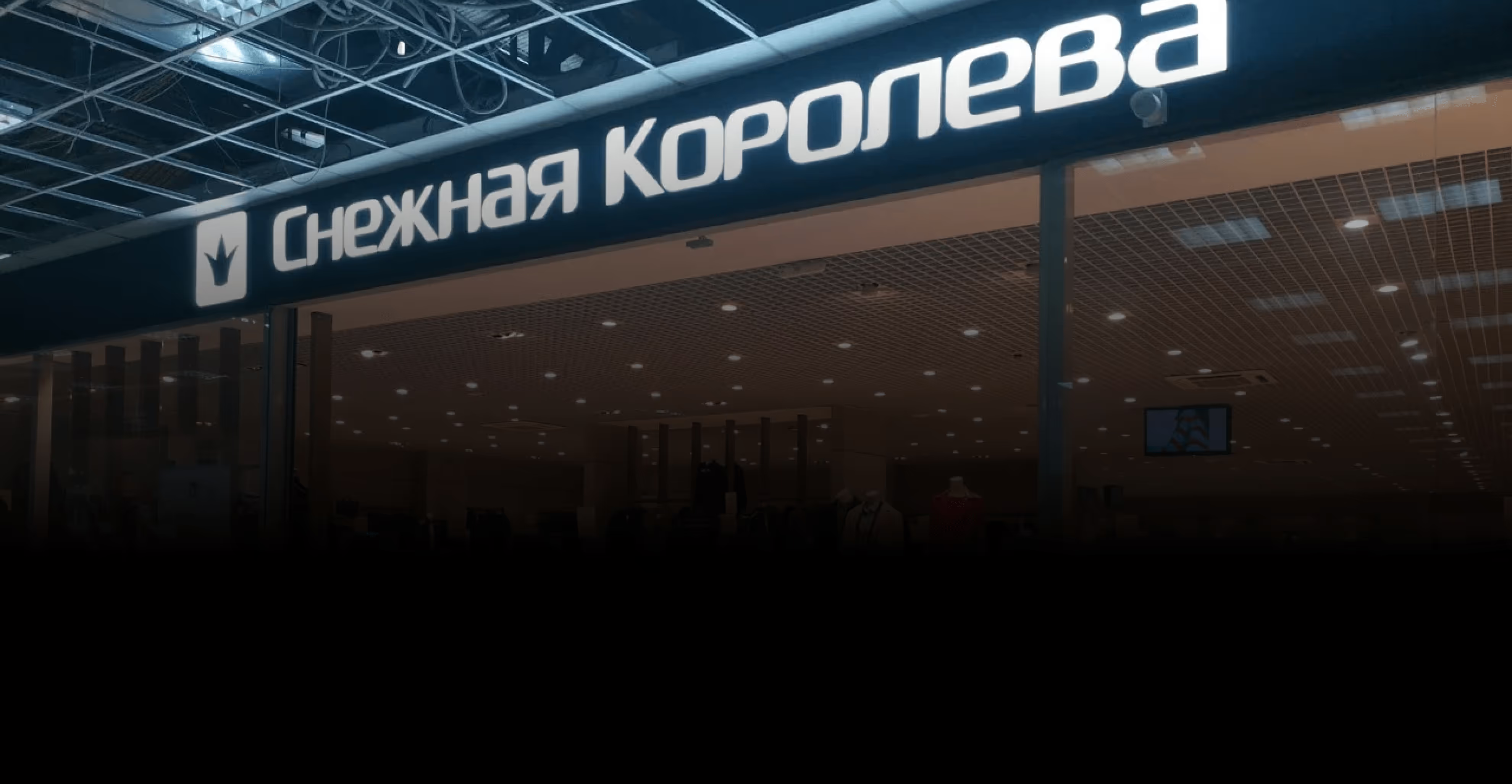
The best — both the developers and the management, and the owners are in a league of their own! What was done at Snow Queen would have taken other companies 10 times longer. And thank you for assessing development sensibly and not stretching out the timelines.
You set a high standard for working with contractors. After you, dealing with others leaves a feeling of falling short of expectations.
After several years of joint, productive work, I want to thank our colleagues at KT.Team. Together we have come a long way, solved thousands of tasks, survived 3 Black Fridays already, and developed and successfully launched several large projects estimated at more than 2,000 person-hours. Both I and the company's management are pleased with our collaboration.
Before KT we had another contractor — a large, well-known integrator — and every change was expensive and painful. We even considered abandoning Magento altogether! kt.team took on a huge amount of work. A great team!