Solutions

Integration with 1C systems via a data exchange microservice

We connect 1C to websites, marketplaces, accounting, and other systems through an exchange microservice and ESB.

Our clients

Clients and partners

Capital Group
FSK Group
SMLT
Tochno
Dogma
Sber City
FM Logistic
Danone
+10clients · View cases →
  1. Connect 1C to the data bus faster and more easily with a ready-made exchange microservice.

  2. It uses OData, so it is compatible with any 1C configuration.

  3. Does not require changes on the service side and does not overload 1C even with large volumes of transmitted data.

  4. Benefits of connecting 1C to ESB through an exchange microservice

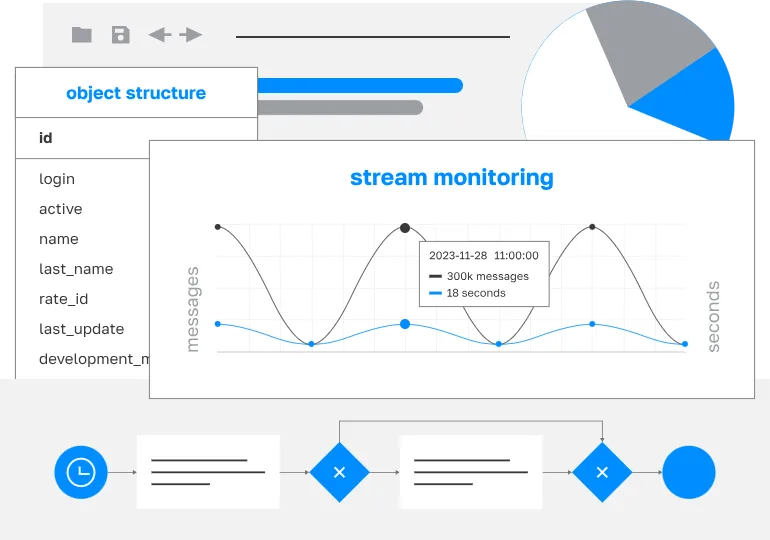
  5. The microservice consists of separate ETL connectors for 1C.

  6. To connect, simply specify in the configuration settings which objects to send to or retrieve from the 1C system.

  7. Does not require changes on the 1C side.

  8. Vendor lock-in risk is eliminated because the microservice is built on popular open source tools (MuleSoft, WSO2, Talend, and others).

  9. You can set up data exchange between two 1C systems.

  10. ESB also makes it possible to connect services from any vendor to data exchange with 1C.

  11. Easily connect even cloud-based 1C solutions to data exchange through the service API.

  12. The exchange microservice uses the standard OData exchange mechanism.

  13. Does not overload 1C even with large volumes of exchanged data.

With ESB integrations, any data transformation logic is available for 1C

Transferring data with the "reference" type To transfer an object of the "reference" type, you must make sure that all reference catalogs have been created in the consuming system. Otherwise, the object will be created incorrectly or the stream will return an error. Our connectors check whether the system contract is met (completeness, correctness). Only when all conditions are met will the message be sent to the consumer Building an object from multiple tables Object information can be stored in multiple sources.

You need to request data from each source and merge it before sending. Our solution lets you aggregate object data. For example, you can collect "orders" and "payments" separately from different sources and pass them as "orders with payments." Deleting a row from an object's tabular section means that row is not registered for 1C exchange. The receiving system must know this 1C behavior and calculate changes on its own. Our connectors can check for deletions in the tabular section. If a deletion occurred, they mark it in the storage.

Consumers do not need to perform calculations.

Current price snapshot

1C does not provide a snapshot of current prices. The consumer must determine which price from the entire register, past, present, or future, is current. Using a storage layer, we calculate current prices so any consuming system can retrieve them without extra logic.

Prevent data loss during exchange between systems

The Problem

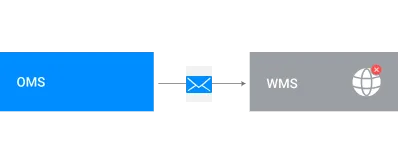
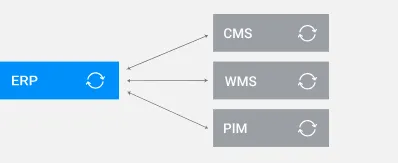
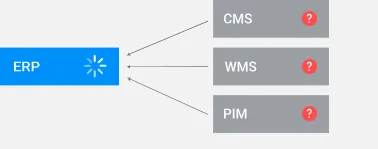
In point-to-point exchange, when one system fails, data may be lost: one system considers the message delivered when the other has not received it.

Solution

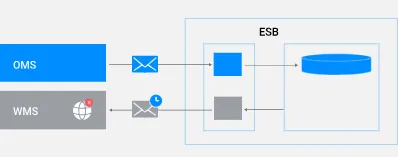
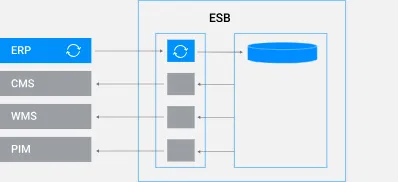
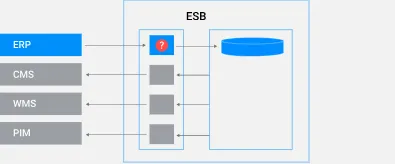
We configure integrations so that if the connection drops, the message is treated as unprocessed and will be sent on the next pass.

Change one IT system without changing the others

The Problem

In the old approach, the source delivers data as is. The consumer must transform it into its own format. With this setup, any change in the source will trigger a cascade of changes in all related data flows.

Solution

Changing the ERP or any other system will not require modifications to all connected systems. If a system changes, only the source-to-storage connectors will be affected. For all consumers, everything will remain unchanged.

Reduce load on systems without changes or added resources

The Problem

The same data is needed by different systems. Consumers duplicate requests to the source system, which increases the load. If a company has one system for storing master data, it will receive a huge number of requests. Often this is an old monolithic system that the business wants to replace in the future.

Solution

Consumers query the warehouse. Load on the main source is reduced without changes to the system itself or additional resources. When it is time to replace the legacy system with several new services, you will only need to change the source-to-warehouse flows. The changes will not affect multiple consumers. Prevent data loss during exchange Change one set of IT systems without changing the others Reduce load on systems Discuss the task

Get a free consultation with an expert

  1. We will define the scope of the problem that is causing business losses

  2. We will outline possible solutions and the tools to implement them

  3. We will define the implementation plan and next steps

  4. You can implement this solution with us, another integrator, or your own team

  5. Our approach and its Risk Free advantages.

  6. If you are not satisfied with the result, you do not have to pay for the work.

  7. We include this clause in the contract. Transferability.

  8. We do not hold clients hostage.

  9. All our solutions can be easily handed over to your team or another contractor.

  10. For us, IT is effective when it delivers business results and enables a high pace of change. Expertise. 400+ successfully launched integrations using different tools (Kafka, MuleSoft, WSO2, and others). Control.

  11. Every integration we launch is monitored by our monitoring system.

A typical workflow

We have structured the implementation process so that you get the maximum benefit. You can go through the entire journey with us. Or you can order any of the steps separately and hand the rest over to your team.

1. Designing a loosely coupled architecture

We will analyze the current IT architecture, AS-IS; work through exchanges for key entities; design the TO-BE architecture; prepare a roadmap for transitioning to the new architecture; prepare recommendations on tools; and prepare documentation. You will receive

A transition plan tailored to your business specifics

2. Migrate your most critical flows

BPMN flow diagrams; deployment and configuration of the required components (ETL, storage, logging, monitoring); connector setup; log collection and integration monitoring setup; documentation and training. You will get

Solving 80% of data exchange problems between systems

3. Migrating the remaining flows to populate the data warehouse

BPMN flow diagrams; connector setup; log collection and integration monitoring setup; documentation and training. You will get

A single enterprise-wide exchange mechanism and complete data for analytics

A team of practitioners, not theorists. Continuous team development and training are built into our processes. Our qualification department, senior developers, and managers constantly update and improve training practices. We do not assign to projects employees who have not successfully completed training in key practices.

110+ experienced specialists on staff 50+ mid-market and enterprise clients 30+ integration implementation projects 10+ years of practice and successful cases In CIS, we are known and valued Top web studios / full-service digital production ranking in CIS Tagline (2023) Ranking: Highload development of complex digital projects: 2021 Transition to data-driven

Data warehouse-driven business solutions

Make business decisions faster with regular dashboards for key metrics Make more accurate conclusions from A/B testing by creating temporary dashboards for a specific hypothesis Reduce the cost of maintaining integrations between services, ensure reliable data exchange, and stay flexible as requirements change Learn more Cases

Built a unified API for fast connection of 200+ 1C:Retail systems

Designed a target system integration scheme for a manufacturing plant. Implemented ESB technology and launched 48 flows

How the SberCity property management system helped Sber automate asset management, speed up processes, and increase transparency

idea
idea

Discuss the solution: Integrating 1C with systems via...

Send via: