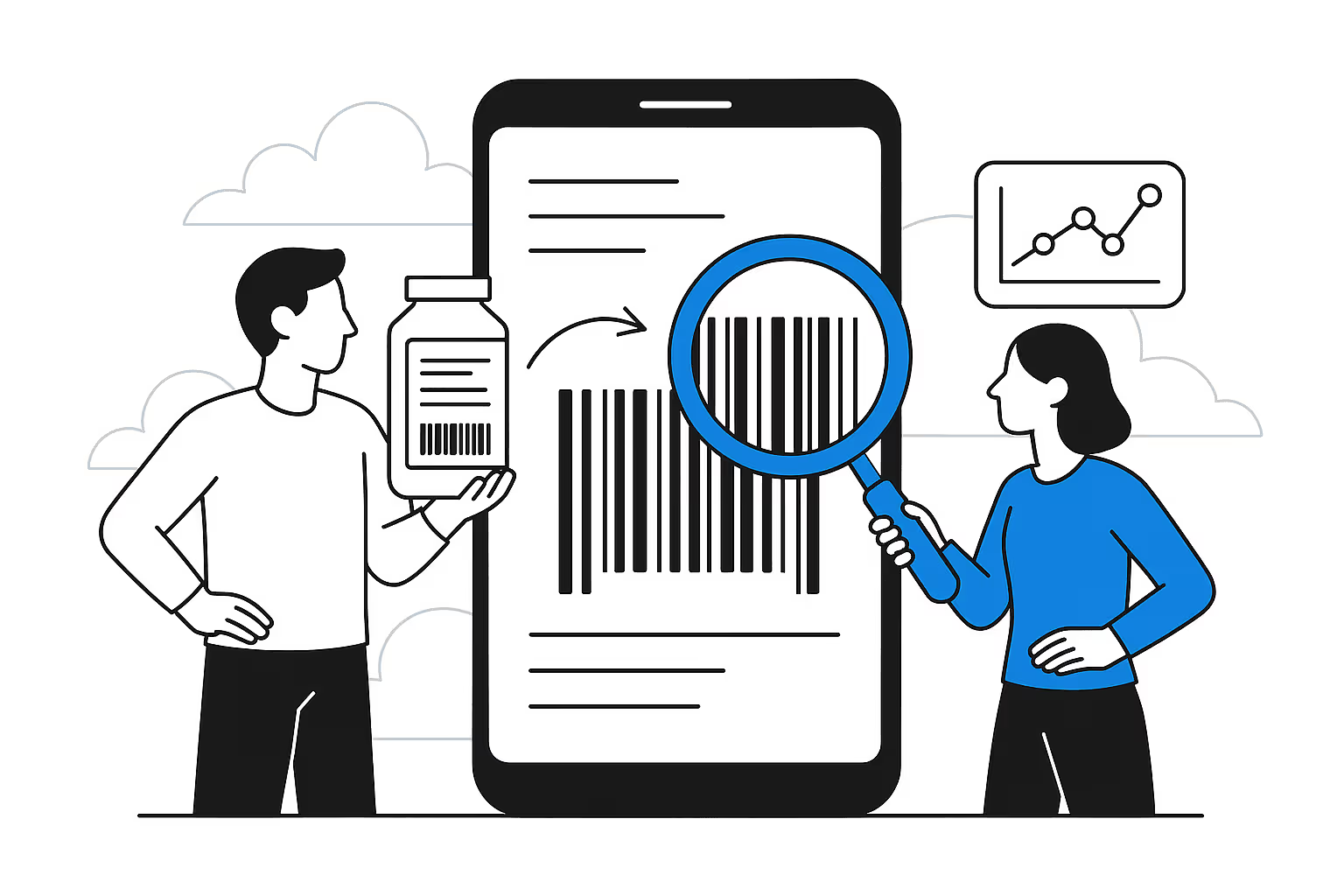
One protocol instead of N×M integrations
A data source is connected once and works with all agents — integration cost and time drop, and one-off connectors stop multiplying.

AI tools
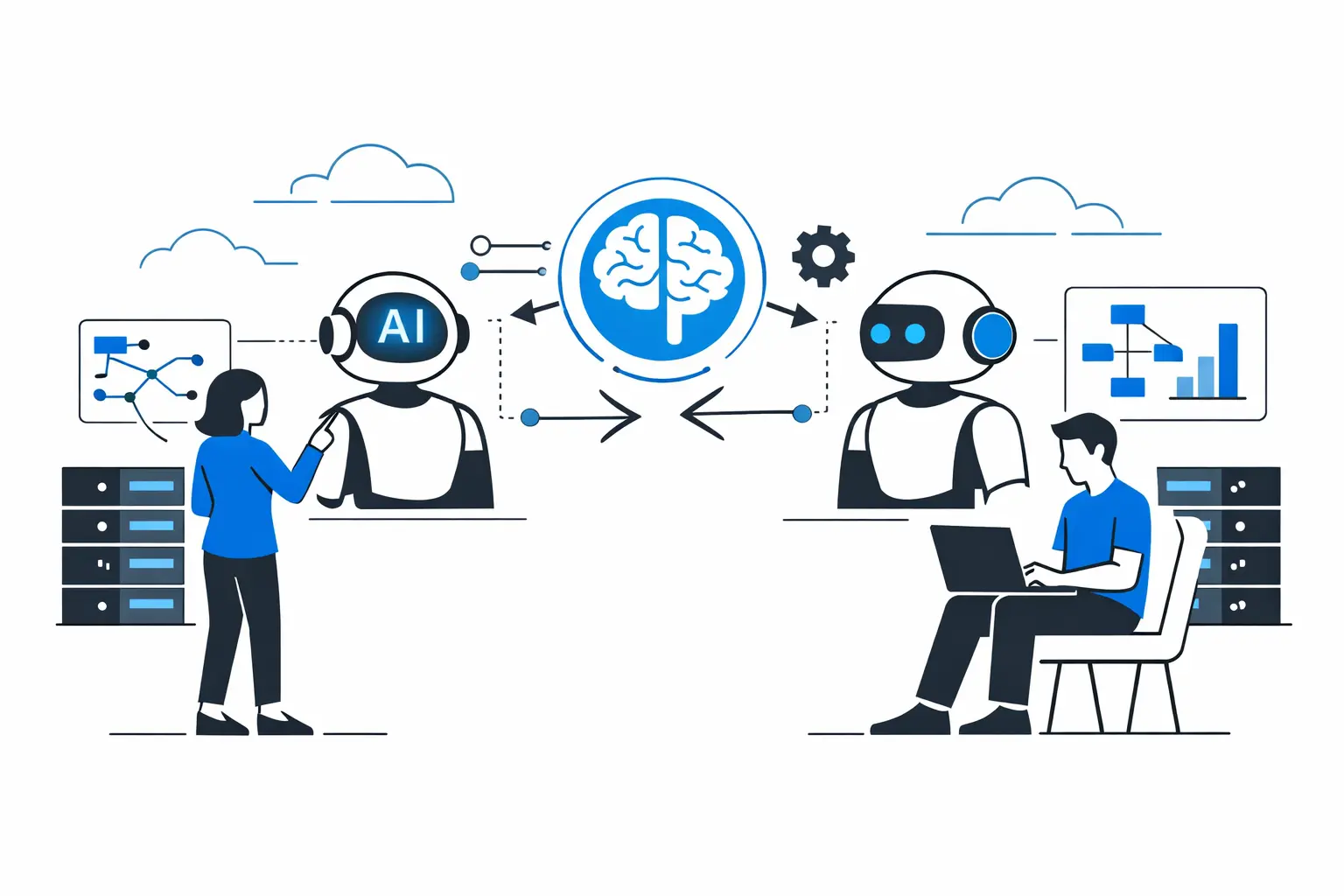
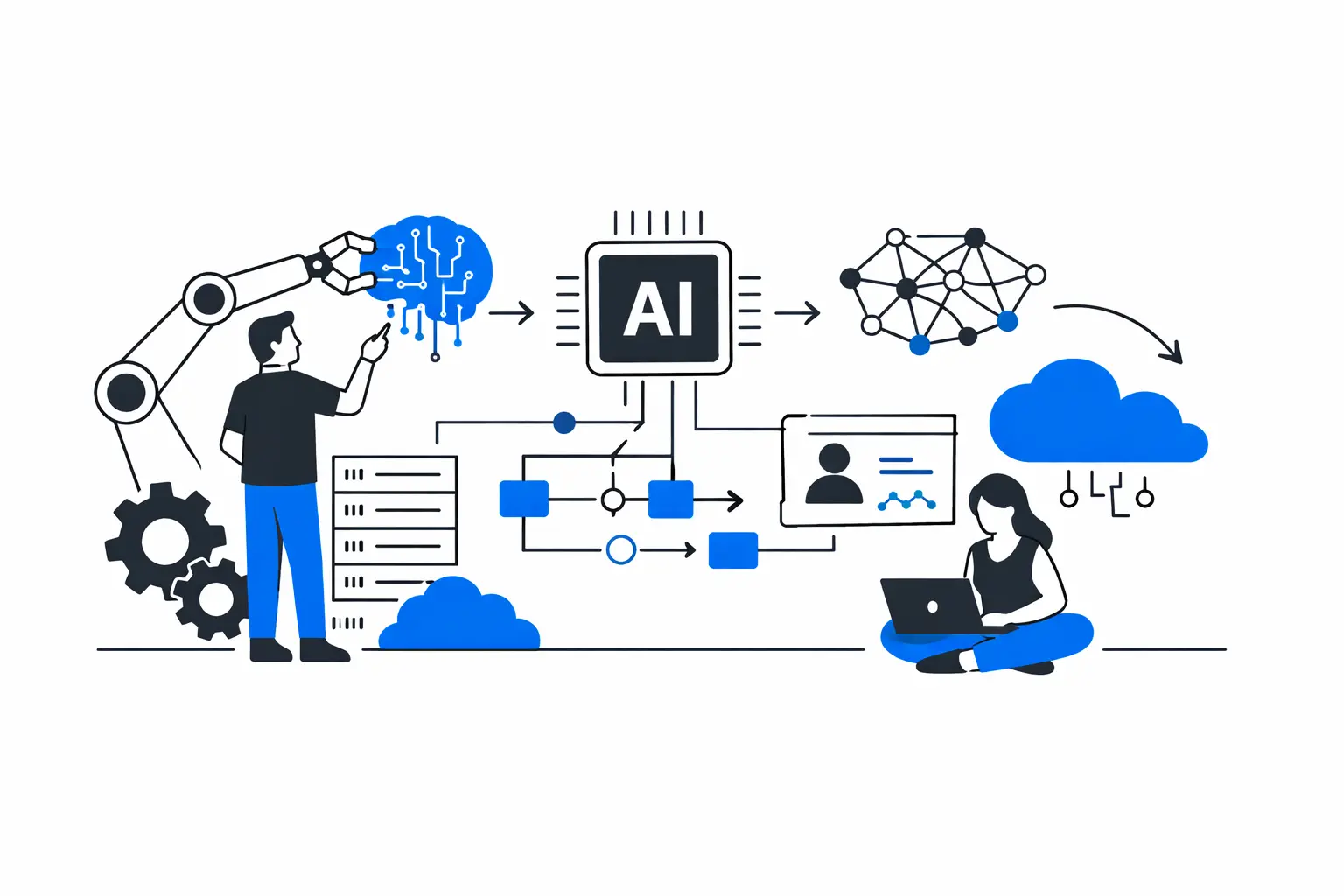
MCP (Model Context Protocol) eliminates the tangle of integrations between AI agents and enterprise systems.
MCP is the USB-C for AI: one standard between sources and the agent makes integrations, memory (Sloy), and orchestration reusable, without model lock-in
Our clients












Industry solutions
Capabilities
A data source is connected once and works with all agents — integration cost and time drop, and one-off connectors stop multiplying.
MCP servers outlive a change of LLM, team or contractor: nothing is rewritten from scratch when a project is handed over.
The agent answers from live data in CRM, Git, BI and files instead of a stale training corpus — fewer hallucinations and manual checks.
OAuth 2.1, centralized authorization and call logging give security teams control over what the agent can access.
The agent not only reads data but also performs actions (create a task, update a record) — automating end-to-end processes, not just prompts.
One MCP server serves Claude, ChatGPT, Gemini, Cursor and Copilot — the company isn't locked into a single vendor.
The agent picks the right tools on the fly instead of hardcoded integrations — new scenarios launch without rewriting code.
The company's work trail (chats, meetings, Git, finance) is served to agents as verifiable memory via MCP — decisions are made on company context.
MCP has been handed over to the Agentic AI Foundation (Linux Foundation) and is supported by OpenAI, Google, Microsoft, and AWS, betting on a standard rather than custom-built code.
Approach
We do not fork or patch the MCP core. MCP remains on the standard updatable version, while customizations are implemented as separate modules or services. Before each update, we verify the compatibility of modules and integrations in a test environment.
Where a mature international solution exists, we use it instead of inventing our own protocol or platform. Before writing code, we study how the problem is already solved in the industry.
The solution is loosely coupled and documented: it can be handed over between teams and contractors without rewriting. You are not tied to us.
AI compatibility
Anthropic transferred MCP to the Agentic AI Foundation; founding members include Block, OpenAI, AWS, Google, and Microsoft. This is not a vendor protocol, but community-driven infrastructure.
Claude, ChatGPT, Gemini, Microsoft Copilot, Cursor and VS Code have first-class MCP integration — one server works with all of them.
OpenAI (Agents SDK, Responses API, March 2025), Google DeepMind (Gemini, April 2025), Microsoft Azure AI Agent Service, AWS, Cloudflare, Bloomberg, Snowflake, Salesforce.
By the end of 2025, MCP support moved from a competitive edge to a mandatory line in enterprise procurement requirements — plan for compatibility in advance.
OAuth 2.1 and centralized governance handle authorization; MCP servers also require supply chain control, and KT.Team connects sources through managed servers.
News
The March roadmap has been expanded from 4 to 5 priorities. Agent identity and SDK developer experience have been added as a separate item; messaging primitives (Tasks, subscriptions/listen, progress) are being extended to server-initiated events via webhooks/channels instead of polling, and the local stdio transport is proposed to be unified with remote HTTP. The release follows the 2026-07-28 specification, the largest revision since the protocol launched.
The largest revision since launch. Protocol-level sessions (Mcp-Session-Id), the initialize/notifications/initialized handshake, ping, and SSE resumability were removed; cross-call state is now carried in explicit handle arguments. server/discover was added, the MRTR pattern replaced server-initiated requests, and resultType became mandatory. Roots, Sampling, Logging, and the HTTP+SSE transport are marked Deprecated (at least 12 months before removal), and Dynamic Client Registration gives way to Client ID Metadata Documents.
MCP server tools can return interactive HTML components, such as dashboards, forms, and multi-step wizards, rendered in an iframe sandbox directly in the chat with the model. The first extension to move from an SEP proposal (November 21, 2025) to official production-ready status.
Protocol anniversary. Experimental task-based workflows were added (SEP-1686, statuses working/input_required/completed/failed/cancelled), Dynamic Client Registration was replaced by URL-based Client ID Metadata Documents (SEP-991), URL mode elicitation for OAuth was added without passing credentials through the client (SEP-1036), tool calling inside sampling requests was added (SEP-1577), and the tool name format was standardized (SEP-986).
Blog
Projects