An AI assistant in a board meeting: where it breaks and how to fix it

AWS released five deep dives in one week, four on model infrastructure. We examine four AI assistant failures and the checks that prevent them.

  • Five articles about the same topic
  • Four ways to embarrass yourself in front of the board
  • How the validation layer works
  • What this means for a company without a GPU cluster

Trigger

  1. In one week, AWS AWS's machine learning blog five technical analyses were published.

  2. Four of them focus on the infrastructure around the model: cluster recovery after a failure, network throughput, storing data in another region, and answer validation.

  3. The NarrateAI case is the most useful one for business.

  4. It is an AI assistant that answers executives’ data-related questions during a business review.

  5. Its authors state plainly: if an incorrect figure on the screen harms someone's reputation, a powerful model alone is not enough. This leads to a rule for executives.

  6. An AI project's budget is split between the model and the validation layer.

  7. In our experience, this infrastructure layer consumes most of the money and time.

Five articles about the same topic

AWS engineers published: - SkyRL on SageMaker HyperPod. RL fine-tuning of agents. In reinforcement learning (RL), the model performs a sequence of steps, receives a reward score for the result, and adjusts its behavior.

One run consumes hundreds of GPU hours, so the cluster must survive hardware failures without losing progress. - MoE models on Amazon EKS with EFA and DeepEP.

Throughput increased by 40%

MoE (Mixture-of-Experts) is a model made up of many “experts”; only some of them work on each token.

The experts are distributed across different GPUs, making data exchange between hundreds of accelerators the bottleneck.

The engineers gained 40% through networking while the model remained unchanged. - HyperPod and Qumulo.

Computations run in one AWS region while the data resides in another.

The team does not copy petabytes or pay a latency cost for every read. - Qwen3-TTS on SageMaker.

A model with 1.7 billion parameters reproduces a person's voice from a short recording without additional training. - NarrateAI on Amazon Bedrock.

Quality control for LLM responses for executives. AWS has no shortage of models or GPUs.

Their engineers still write about reliability, networking, and validation.

We see the same thing in our projects: this is exactly where they break.

Four ways to embarrass yourself in front of the board

  1. The authors of NarrateAI identify four failures that appear only in production. Fabricated metric. The model writes "margin increased by 3 points"

  2. , although no such figure exists in the data. The statement sounds plausible, and no one double-checks it during the meeting.

  3. The error is discovered a month later, after the figure has already informed a budget decision. API limits (throttling).

  4. The model provider limits the number of requests per minute.

  5. Ten participants ask questions at once, and the assistant falls silent at the worst possible moment. Validation delay.

  6. Each control layer adds seconds.

  7. During a meeting, everyone notices a pause in the response, and people stop asking the assistant questions. Evaluative language. "Significant growth," "a weak quarter."

  8. The model gives an assessment it was not asked for, while the executive is held accountable for the wording.

Assess where AI can deliver impact in your process

How the validation layer works

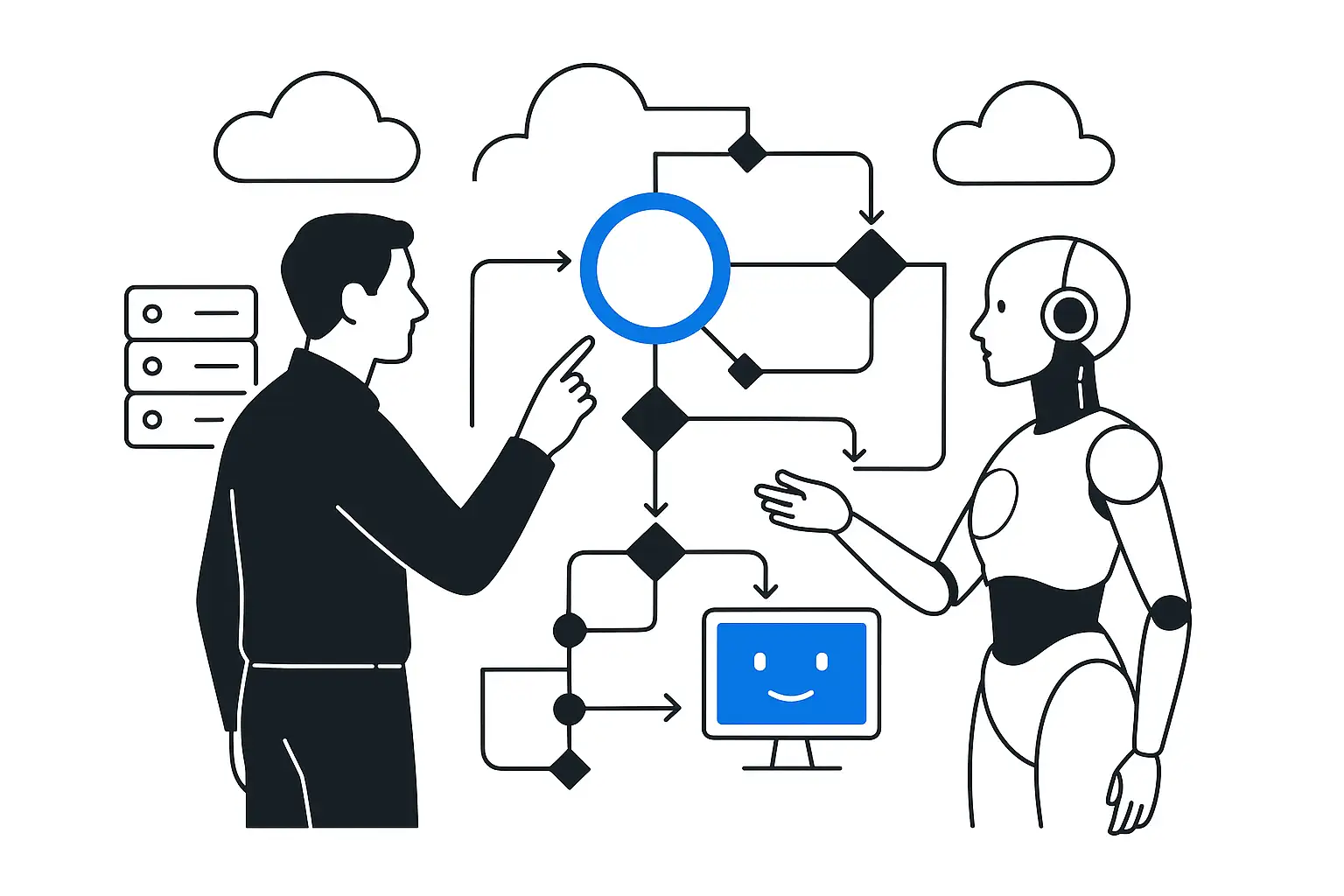
  1. We build such systems with four layers, one for each failure. ### Code calculates the numbers

  2. The model converts the question into a query to the data store: SQL to a data mart, or an API call to 1C or ERP.

  3. The system does the calculations; the model only turns the result into text.

  4. Data access runs through MCP, a standard protocol that lets the model call tools with predefined permissions. ### The validator checks the answer against

Source

  1. Separately, a dedicated step extracts numbers from the answer and compares them with the query result.

  2. When the results diverge, the user does not see the answer: the system either generates it again or says, “There is no such data.”

  3. The check runs in parallel with generation and adds almost no latency. ### The gateway handles the load

  4. Requests to models pass through the LLM & Security Gateway.

  5. It queues requests, caches frequent questions, switches to a backup model when the primary reaches its limit, and keeps personal and commercial data from leaving the system. ###

  6. The dictionary prohibits evaluations without a threshold

  7. The word “growth” is allowed only with a number and a time period.

  8. The validator removes evaluative adjectives if the reference directory contains no threshold defined by the business.

What this means for a company without a GPU cluster

  1. An average CIS business does not train MoE models on hundreds of accelerators.

  2. It connects Qwen, GigaChat, or YandexGPT through an API, or deploys an open model on its own server.

  3. It has the same four failures listed for NarrateAI: the model makes things up, the provider imposes limits, validation slows things down, and wording becomes inconsistent.

  4. The key metric here is TTU, time to use: the time from launch to the first decision made with the tool.

  5. If an executive does not trust the assistant, TTU is infinite regardless of the model.

  6. A one-line answer looks simple on screen.

  7. Behind it are data queries, reconciliation, queuing, and a glossary, and someone will have to do this engineering work.

  8. We apply the same principle in PIM projects when generating product card text, facets, and taxonomy.

  9. The model suggests text or a category, rules check the attributes against the reference directory before publication, and people see only what has passed validation.

Conclusion

A model can be chosen in a week. The layer that makes its answers suitable for decision-making takes months to build, and four of AWS's five articles show where those months go. An executive who once caught an assistant inventing a figure is unlikely to give the project a second chance. That is why I consider an AI assistant ready when every number in its answer has an address in the data source.

Source

Discuss the article: AI Assistant in a Board Meeting: Where...

Enter your email or phone number so we can get back to you.

Send via: