Location-based storage
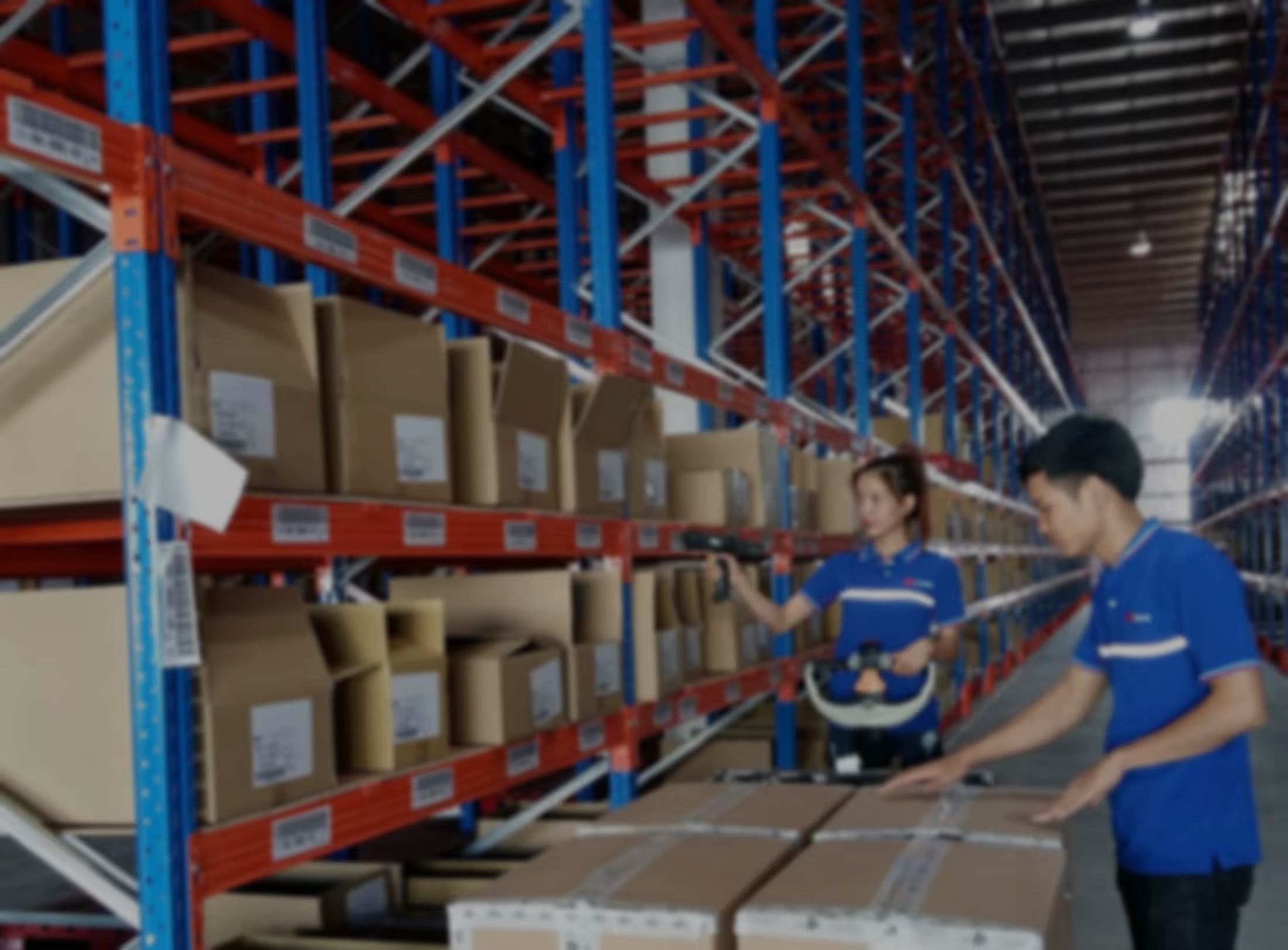
Every item has a location, and every location has putaway rules. A new employee finds goods by terminal task, not by asking whoever “knows where it is.”

We implement a 1C-based WMS for address storage, picking, and shipping. We improve inventory accuracy and warehouse operation speed.
Our clients













Location-based storage, bins, cross-docking, and picking on the platform you already have. The warehouse runs by system, not by memory, without moving accounting into a separate system.
Every item has a location, and every location has putaway rules. A new employee finds goods by terminal task, not by asking whoever “knows where it is.”
Receiving, putaway, picking, and shipping are sent to handheld terminals as tasks with barcode verification. Mis-sort errors are caught at the moment of the operation, not during inventory.
The warehouse lives in the same 1C where orders, purchasing, and cost accounting are handled. There is no need for a separate exchange between the WMS and accounting, and no need to reconcile two versions of stock balances.
Counting is done by zone and cyclically, not in one emergency run once a year with the warehouse closed.
Topology, zones, storage layout, shift operation volume, and where time is currently lost. Without this, configuring putaway rules becomes guesswork.
Zones, bins, and putaway and picking rules tailored to your item master and turnover. This is what determines whether the warehouse gets faster or just more rigid.
Terminals, scanning, labels, integration with existing equipment. The engineering layer that makes tasks executable.
Warehouse staff go through the process on real tasks, not a presentation. This is where scenarios that are not in the procedure surface.
First one zone, then the rest. This keeps the warehouse running and leaves a rollback path.
KT.Team experience
Warehouse processes integrated with the accounting system: stock balances, inventory counts, and data exchange between systems.
FAQ
Warehouse structure: bins, zones, routes, and statuses. Receiving, location-based putaway, picking, cross-docking, and shipping all run on this framework; without it, automation becomes only an electronic copy of the old chaos.
Handheld terminals, scales, and label printers on the warehouse side; 1C:UT and 1C:ERP, logistics, and BI on the systems side. All product movements are recorded in real time and linked to documents.
No. The WMS is introduced in stages, by zone and by shift, with staff training at each step. This lets you test scenarios on part of the warehouse before the full flow is moved over.
The WMS adapts to your way of working, from FMCG and retail to B2B logistics and manufacturing, and supports shift schedules and unique goods-handling scenarios, including non-standard packaging and picking workflows.
Receiving, storage, shipping, and inventory data live in one system and update instantly. Discrepancies are visible at the moment of the operation, not after the recount at period end.
Next step
We will review the layout, operation volume, and current losses, and state plainly whether the 1C system is enough or a separate system is needed.