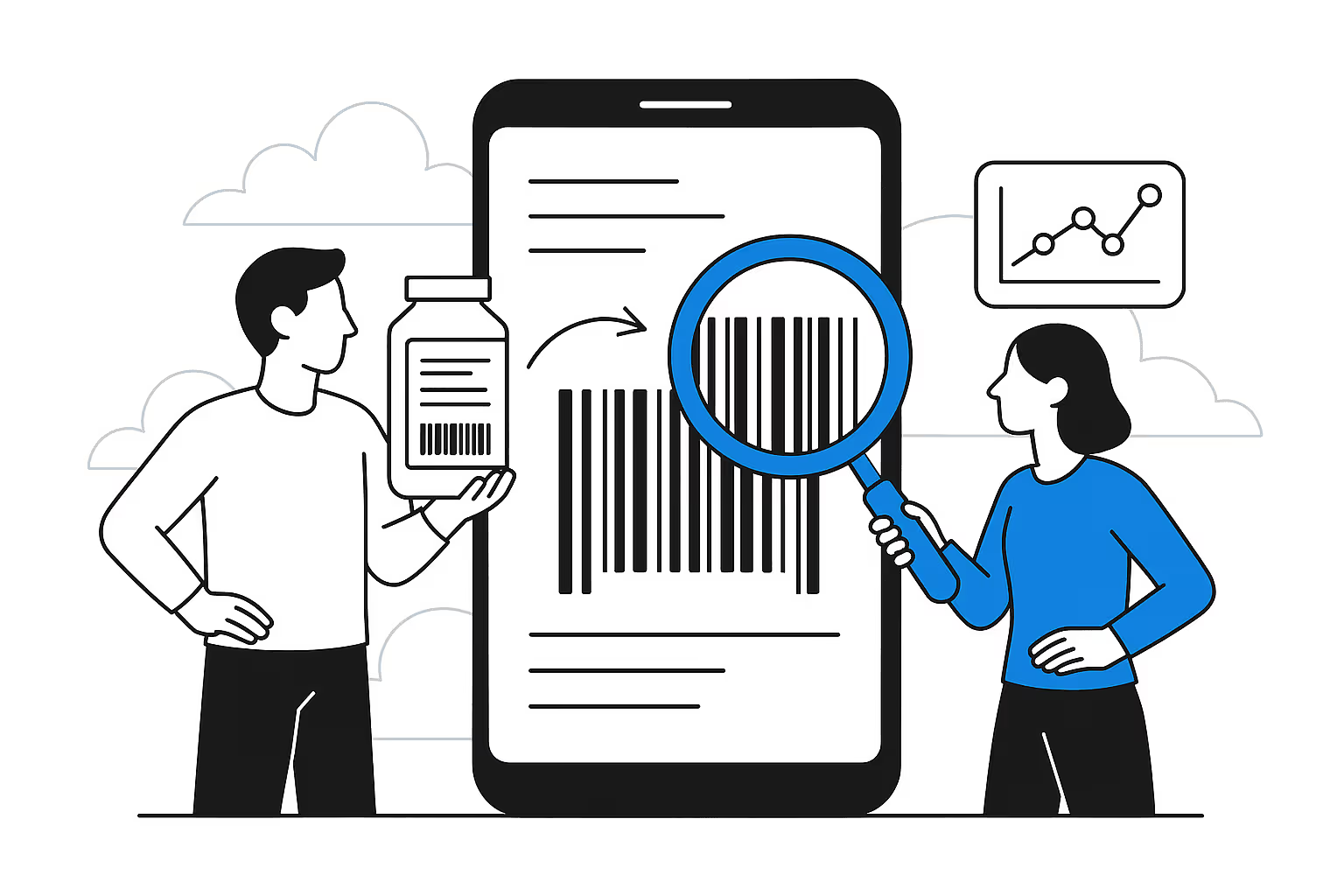
Physical flow
Bottles and boxes pass through sensors, scanning, assembly, and rejection.

How to connect conveyors, Data Matrix codes, operator workstations, 1C, and Honest Sign to ship cosmetic sets without code loss or line stops.
Process map
The line confirms each nested code, creates the set code, rejects exceptions, and sends the validated result to 1C and Chestny Znak.
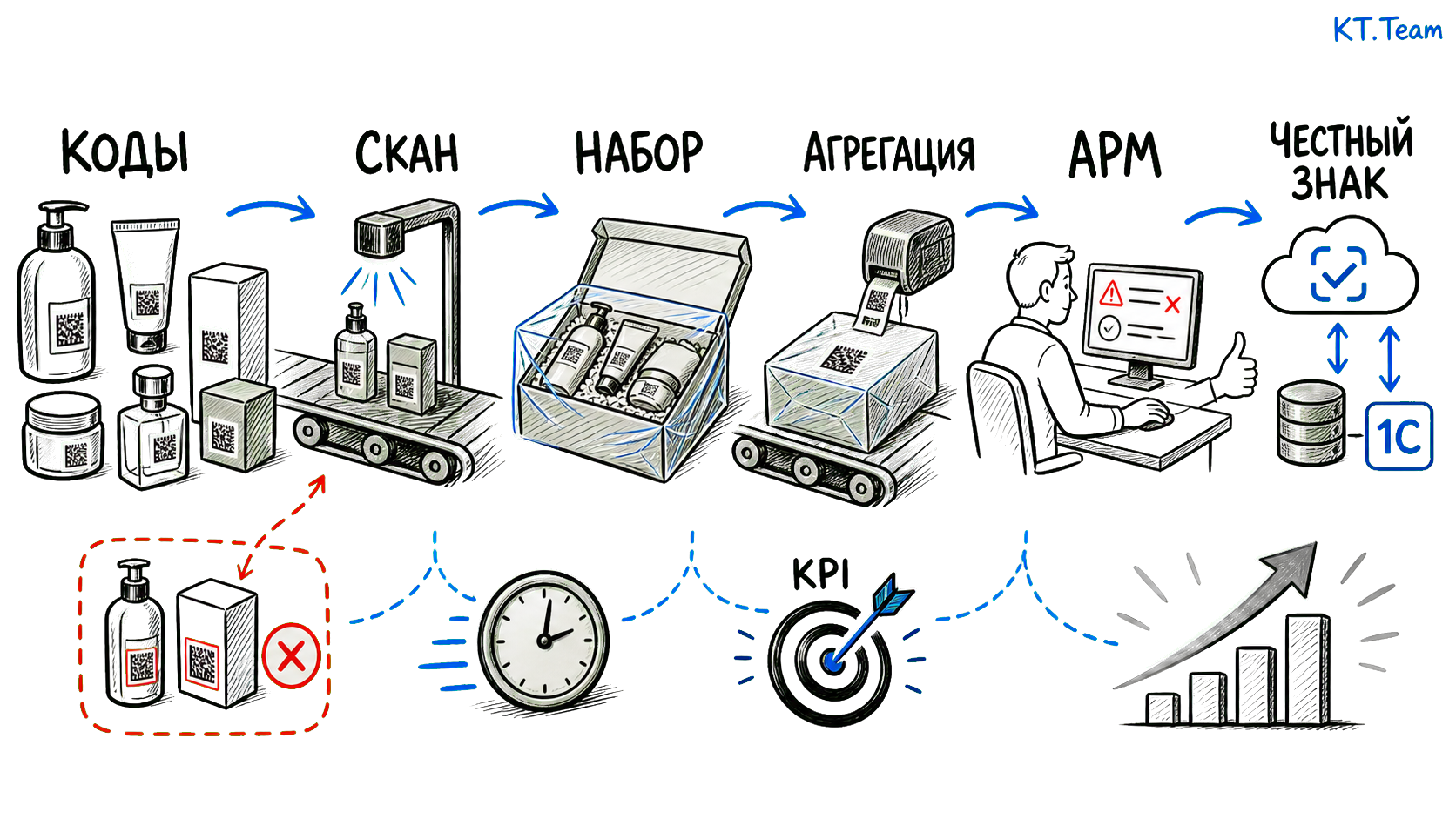
Bottles and boxes pass through sensors, scanning, assembly, and rejection.
The system checks uniqueness, task composition, and the status of each Data Matrix.
The workstation shows the task, the stop reason, and the safe action for an exception.
1C stores the production record, while GIS MT confirms code operations.
Growth in the online channel increases the number of short runs, promo sets, and configurations for different marketplaces. Production has to change kit contents faster than the base item master changes. At the same time, cosmetic labeling has already become part of the mandatory production process.
Two flows meet on the line. The physical flow moves bottles, inserts, and boxes. The digital flow links the GTIN, individual codes, production order, set code, 1C documents, and the operation status in GIS MT. This junction is handled by 1C integration with Chestny Znak: codes, documents, and statuses must match without manual transfer. An error in any stream turns into a stoppage, rework, or inventory discrepancy.
Conveyor speed alone no longer defines throughput. The bottleneck is the slowest control step: reading, composition verification, label printing, operator confirmation, or exchange with an external system.
Mandatory labeling for cosmetics and household chemicals was introduced in stages in 2025: from May 1 for soap and detergents, from July 1 for hair care, shaving products, and deodorants, and from October 1 for a broad group of cosmetics and oral hygiene products. The specific obligation is determined by the EAEU CN FEA and OKPD2 codes in the authorization documents.
From July 1, 2026, retail sales of marked cosmetics are transmitted to the system through the cash register. For circulation and non-retail withdrawal, volume-and-sort accounting applies: GTIN and quantity are transmitted in documents. Under the new version of Decree No. 1681, information on specific codes in circulation will be transmitted for goods produced from July 1, 2030. Most of the amendments approved by Decree No. 656 of May 30, 2026, take effect on September 1, 2026.
A deferral of item-level transfer between participants does not remove the production task. The manufacturer still has to prove which codes were applied, which units went into the set, which code was rejected, and which set was actually produced. This data is needed for commissioning, discrepancy investigation, and controlled line operation.
| Entity | What it is used for | What the system connects |
|---|---|---|
| Set | Several items are sold as one consumer unit | Set code, composition, item codes, and quantity of each item |
| Group packaging | Identical consumer units are grouped for circulation | Group packaging code and nested codes |
| Transport packaging | A box or pallet is used for logistics | KITU/SSCC and lower nesting levels |
| Delivery kit | The goods are assembled for a specific order but do not form a new product | Order, line items, and code output rules without creating a new item card |
The National Catalog stores the composition, incoming item code, and quantity for a card of the "Set" type. KIGU may be used for promo sets. KITU is used for transport aggregation. Before automation, you need to define which entity a specific line operation creates: the same outer box does not yet mean the same legal and accounting scenario.
Manual flow
Controlled loop
| Option | When it fits | Constraint |
|---|---|---|
| Mobile data terminal and manual scanning | Small batches, low line speed, frequent composition changes | Throughput depends on the operator; it is harder to guarantee sequence and prevent skips |
| Fixed scanner + workstation | Stable passage of the item through the checkpoint requires composition verification and automatic rejection | Requires testing on real packaging, lighting, speed, and code orientation |
| Machine vision + PLC/conveyor | High speed, multiple inspection zones, simultaneous checking of the code, cap, label, and package geometry | Higher equipment and commissioning cost; economically justified only when the line has a measurable bottleneck |
The choice cannot be made from the equipment catalog alone. The same Data Matrix reads differently on a matte bottle, glossy film, a curved surface, and a transparent label. First, test on real packaging and at real speed, then fix the optics, lighting, camera position, and defect criteria.
Packaging flow for a marked set
Task
Scanning
Assembly
Set code
Confirmation
| System / layer | Scope of responsibility |
|---|---|
| 1C / ERP | Item master, production order, batch, release documents, and accounting result. |
| Code service and integration layer | Code retrieval, status checks, operation queue, duplicate protection, log, and redelivery. |
| PLC, sensors, scanners, cameras | Item passage, reading, conveyor synchronization, and rejection signal. |
| Operator workstation | Shift task, progress, exception reason, manual confirmation of allowed operations. |
| GIS MT Chestny Znak | The code's official status and receipt of information about operations required by the rules. |
Measure line takt time, operator actions, packaging types, SKU changes, current errors, and points where the physical product diverges from inventory records.
Check printing and reading at operating speed, with different orientations, glare, contamination, film wrinkles, and label misalignment.
The system reads the flow and compares the result with the operator, but does not yet control the conveyor. This makes false rejections visible without risking a production stop.
The operator receives instructions for duplicates, skips, incorrect SKU, label defects, and unavailability of the external system.
After acceptance, include writing to 1C and GIS MT in the KPI, then roll out the validated template to other SKUs and lines.
| Open example | What was automated | Practical takeaway |
|---|---|---|
| CEWE and Zebra | Fixed reading of up to 22,000 barcodes per hour on production lines; figure stated by the equipment vendor | A fixed scanner can run at high speed if the code position, lighting, and process geometry are stable |
| Rexona / Unilever and Cognex | Cap integrity and color, date code, label position, and product code are checked at the same time | Machine vision is justified when one control point covers several measurable defects |
| GS1 DataMatrix Guideline | Data structure and print quality are assessed separately under ISO/IEC 15415 | Successful reading by a single scanner does not replace symbol quality verification |
These examples show technical feasibility but do not define the target KPI for a specific line. Throughput and accuracy are accepted only based on tests on your own SKU, packaging, and speed.
Production-tested
Line diagnostics
We will document the physical and code flow, check packaging and exceptions, define the minimum pilot scope and acceptance criteria. The result is a process diagram, integration boundaries, and a decision on which equipment is actually needed.
FAQ
The scenario depends on whether the package is a set, a group package, or a transport package, which goods are inside, and how the set is registered in the National Catalog. The entity type must be determined under Resolution No. 1681 and the product cards before line setup.
Yes, if the line speed and batch volume let the operator keep pace. A manual flow is also useful as a benchmark for the pilot. Moving to a fixed scanner is justified once delays, misses, and the cost of manual inspection have been measured.
Scanning confirms reading by a specific device under specific conditions. Verification assesses data structure, contrast, modulation, damage, and readability margin using a standardized method. The difference is especially noticeable for glossy and curved cosmetic packaging.
The process must separate local assembly confirmation from the external operation status. The task is stored in a queue with a unique identifier, resending is done without duplication, and the operator can see whether the physical flow may continue under the approved procedure.
Start with the process model and packaging tests. After that, the responsibilities of 1C, the integration layer, the workstation, the scanner, the camera, and the PLC become clear. Buying equipment before these checks increases the risk that it will not handle the real surface, orientation, or speed.
Checked on: 03.08.2026