GitHub HydraFusion: Orchestrating Models

GitHub launched Project HydraFusion, orchestrating multiple models in Copilot. Analysis: why businesses need a model pipeline and how to manage governance.

  • An orchestrator instead of a choice
  • Why one model is no longer enough
  • What lies behind the word “orchestration”
  • Governance catches up with launch speed

An orchestrator instead of a choice

GitHub introduced Project HydraFusion, a runtime orchestrator for Copilot that creates an execution plan and distributes the task among models from different providers: one model drafts, a second critiques and edits, and for a complex task the chain cascades to a more powerful model. Previously, GitHub addressed this problem more simply: Auto model selection chose one suitable model for the task. HydraFusion changes the unit of work: it used to be a model; now it is a model pipeline.

Why one model is no longer enough

  1. Auto model selection answered the question, “Which model will handle this task best?”

  2. The question was static: the choice was made once, before work began.

  3. Real development tasks do not work this way: code drafting, logic review, and final editing require different strengths, and no single model excels at all three. GitHub formalized this as an architecture: an execution plan, model roles within the plan, and a cascade point.

  4. For a company that has already adopted Copilot or a similar assistant, this means buying the “best model” is no longer the solution—the solution is a pipeline with switching logic.

What lies behind the word “orchestration”

  1. The mechanics are simple on paper and difficult in production.

  2. A fast, inexpensive model writes the first draft.

  3. The second model—not necessarily the same as the first—acts as a critic, finding logical gaps, style violations, and overlooked edge cases.

  4. If the critique shows that the task is more complex than expected, the system cascades to a more expensive frontier model instead of running it for every request.

  5. The economic impact is measured in TTU: the time from a developer’s request to a working result decreases because the expensive model is activated only where it is genuinely needed.

  6. This is a case where the simple outcome is “code ready quickly and without gaps”

  7. - requires complex routing engineering under the hood.

Discuss your challenge with an architect

Governance catches up with launch speed

  1. Orchestrating multiple models simultaneously creates a second task: managing this fleet. On the same day MAI-Code-1-Flash was released, GitHub announced its deprecation in all Copilot modes: chat, inline edits, autocomplete, and agent mode. Teams that hardcoded a specific model into a pipeline or policy face an unplanned migration without time to prepare.

  2. The response to this class of problems is enterprise managed settings for Copilot in JetBrains: administrators gained centralized control over plugins, MCP server access, telemetry, and permission modes.

  3. This indicates that the more models and integrations involved in development, the faster a company without a single control point loses visibility into what is happening.

  4. Meanwhile, CodeQL 2.27.0 added native Linux ARM64 support and a new security query for Rust, expanding coverage for Java/Kotlin and C#.

  5. The growing number of platforms and languages for which code is generated—including by models—requires static analysis to evolve with them rather than lagging by a quarter.

How this is addressed technically

In KT.Team projects, this architecture is not new but a proven pattern: LLM & Security Gateway already routes requests among Anthropic Claude, OpenAI, Google Gemini, YandexGPT, and GigaChat based on the task, cost, and data requirements, with access policies and an audit log layered on top. MCP defines the interface between the agent and tools so that changing the model within the pipeline does not break the contract with the rest of the system.

For regulated data, this adds something public Copilot does not provide by default: control over where each step of the draft-critic-cascade chain is physically executed.

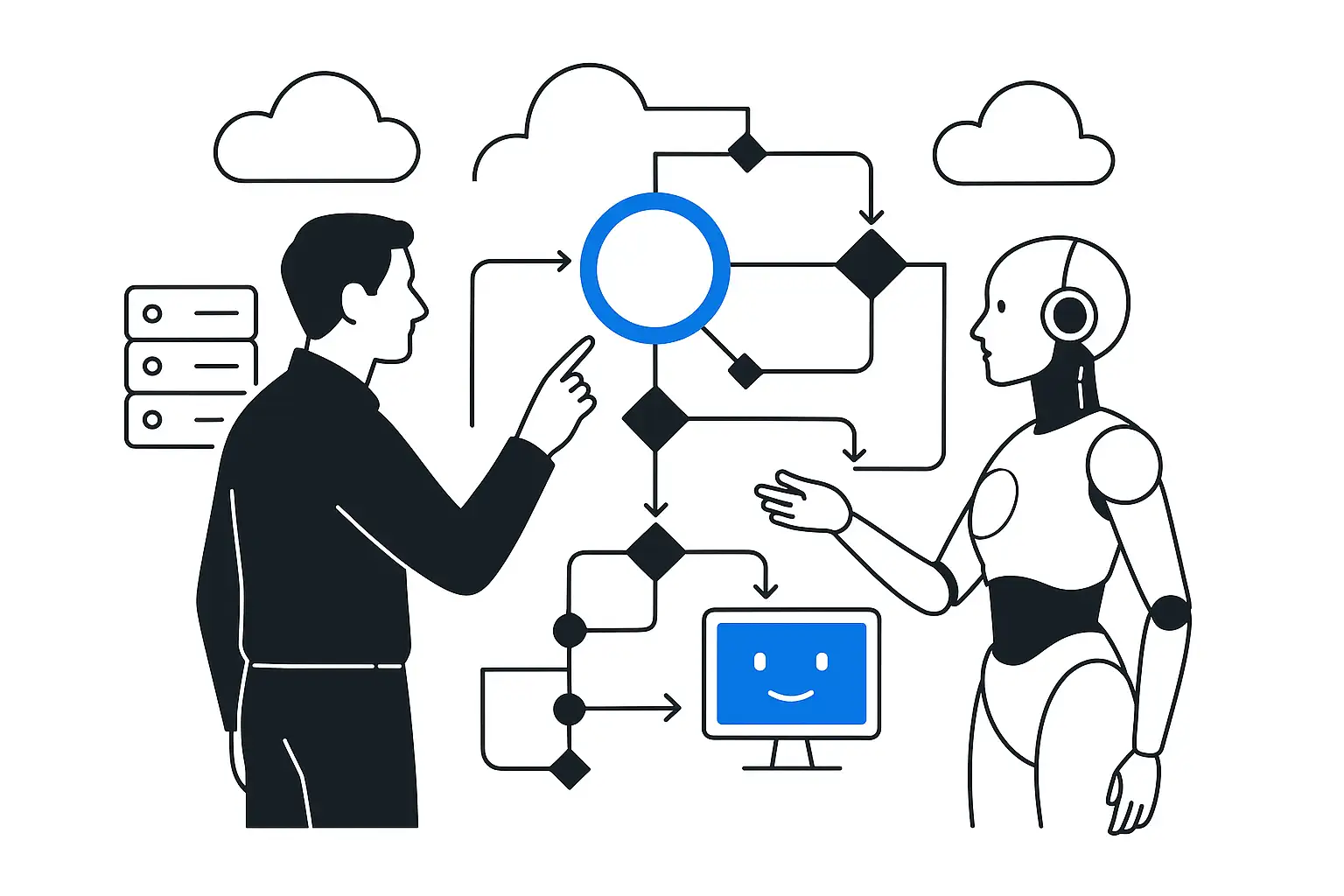
The simple “one chat with an assistant” interface

Routing on the outside, model version control, access policies, and security scanning under the hood—that is exactly the work that separates production from a demo.

Conclusion

HydraFusion captures the industry’s shift in focus: not “which model to buy,” but “how to manage a model pipeline that changes faster than it can stabilize.” A model deprecated on announcement day, rising security coverage requirements, and the growing number of models and integrations to administer are all the same infrastructure burden, visible only after orchestration is already running.

Companies without a routing and governance layer between themselves and model providers risk an emergency migration during the workday.

Discuss the article: GitHub HydraFusion: model orchestration…

Enter your email or phone number so we can get back to you.

Send via: