The state of the IT industry in 2026: three worlds moving at different speeds

What Gregory Orosz saw at OpenAI, Anthropic, Ramp, and Uber, and how leaders can apply it without paying for AI theater.

  • Where the snapshot came from
  • Three worlds moving at different speeds
  • Where the gains are lost
  • What this means for a company without its own lab

Where the snapshot came from

Gregory Orosz, author of The Pragmatic Engineer, delivered a keynote at the LDX3 conference in New York to 2,000+ engineering leaders, CTOs, and staff engineers. He assembled a snapshot of the industry from three

Source

  1. : AI labs, venture-backed startups, and Big Tech.

  2. The presentation analysis has been published in the author's newsletter. For the presentation

  3. Orosz spoke with people at OpenAI and Anthropic, studied how Ramp and Uber operate, and obtained unpublished data from GitHub, Factory AI, and Linear.

  4. The sources vary: the inner workings of labs, the practices of companies building products around AI, and telemetry from tools used by thousands of teams.

  5. This sample is more useful than opinions from the stage.

  6. The lab can see how its engineers write code with its own models.

  7. The task tracker and code hosting platform show what actually made it to release.

  8. These pictures diverge, and that divergence reveals the real gains from AI-assisted development.

  9. The key message for business leaders: three worlds move at different speeds, and copying someone else's pace without your own outcome metric means paying for theater.

Three worlds moving at different speeds

  1. In AI labs, the tool and its user work in the same building.

  2. The model improves, and engineers adapt the process to it that same day. Between “the capability appeared”

  3. and “embedded it into the workflow,” there is almost no delay.

  4. Venture-backed startups buy speed with investors' money.

  5. Their growth metric allows bets on practices that may pay off in a year—or never. Big Tech and traditional businesses have legacy systems, procedures, security requirements, audits, and people accountable for downtime.

  6. Practices from the first two worlds arrive here with losses: the code was generated in an hour, but review, testing, and deployment took as long as before.

Where the gains are lost

Our hypothesis based on this picture: coding speed is no longer the bottleneck.

The bottleneck has shifted to testing, integration, and operations

Suppose an assistant writes twice as much code while the number of reviewers and pipeline throughput remain unchanged. The review queue then grows.

The “lines of code per day” metric improves, while “time from idea to working feature” remains unchanged.

That is why our key metric is TTU, time to use: how long it takes for the tool to deliver a result to the user.

An impressive demo does not affect this metric.

Assess where AI can deliver impact in your process

What this means for a company without its own lab

For a leader responsible for budget and deadlines, this leads to three practical conclusions. ###

Choose the metric before choosing the tool

The metric should measure outcomes: time from task to production, the share of releases requiring rollback, and support costs.

These figures are available to any team with a history of tasks and commits.

The tracker data cited by Orosz is built on them as well. ###

Adapt someone else's operating model to your conditions

A startup practice built around a freely chosen stack will not work in a bank or industrial company. Ask which part can meet your security requirements and integrations, and take only that part. ### Calculate the cost of context

A model without access to your systems gives generic answers

With access, the answers become useful, but you then need to decide which data and actions you allow it to use.

How this is addressed technically

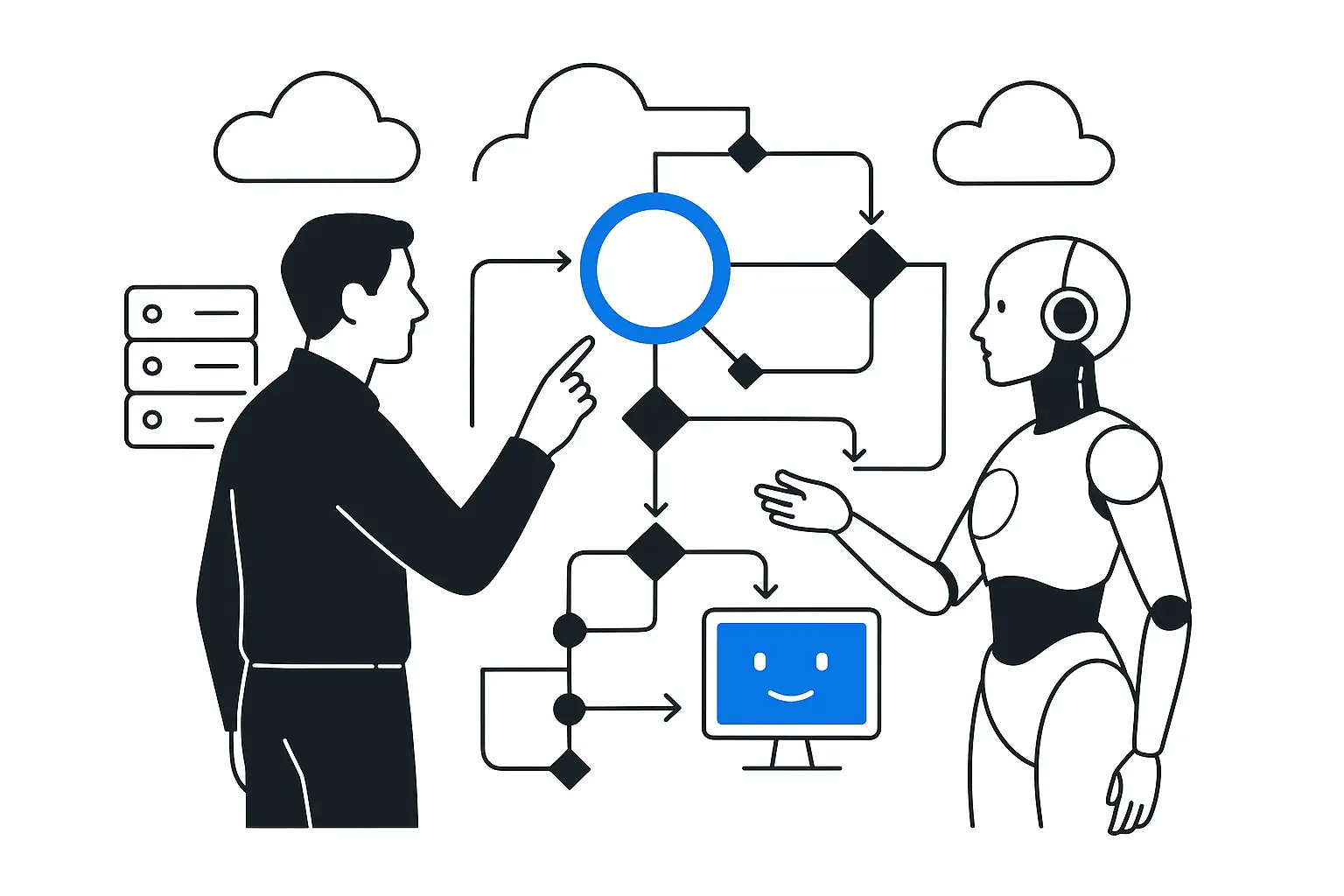
  1. We build AI-native development so that faster coding is not bottlenecked by the rest of the workflow. Generation, review, deployment, and production monitoring form one chain, and we measure it as a whole.

  2. The model accesses enterprise systems through MCP: the server describes which tools and data are available, and the model can call only those.

  3. For answers based on internal documents, RAG works by grounding the model in retrieved fragments of your data and showing where they came from.

  4. An LLM & Security Gateway sits between users, applications, and models.

  5. The models can be anything: Anthropic Claude, OpenAI, or local Llama and Qwen models.

  6. The gateway logs requests, removes personal data leaks, and lets you switch model providers without rewriting applications.

  7. From the user's perspective, everything looks simple: an employee asks a question and gets an answer.

  8. Behind this simplicity is substantial engineering: access controls, logging, quality evaluation, and rollback.


Verdict

Industry leaders move fast, and those who connect speed to outcomes win. A leader who can quantify how their business changed after a year will be better positioned than one who bought the most prominent tool. AI that does not move a metric remains an expense, and expenses are reviewed first.

Source

Gergely Orosz, «The state of the tech industry in 2026», The Pragmatic Engineer: https://newsletter.pragmaticengineer.com/p/the-state-of-the-tech-industry-in

Discuss the article: State of the IT Industry in 2026: Three Worlds at…

Enter your email or phone number so we can get back to you.

Send via: