











1C and CRM Integration for Sales

Managed two-way exchange between your 1C environment (ERP, Trade Management, Accounting) and CRM - Bitrix24, amoCRM, or 1C:CRM: unified customer data, current prices and stock, and orders from CRM go into 1C without retyping.

Our clients

Clients and partners

Capital Group
FSK Group
SMLT
Tochno
Dogma
Sber City
FM Logistic
Danone
Relief Center
Pandora
1C CRM Sales Management for B2B
Saint-Gobain
Askona
FIX PRICE
Snezhnaia Koroleva
Muztorg
TVOE
Greenway
Polaris
Campari
Yandex
Lenta
International perfume and cosmetics brand
1C CRM Sales Management for B2B
RAEC
EKF
L'Etoile
Inventive Retail Group

What Is 1C and CRM Integration

1C and CRM integration is managed two-way exchange between your 1C landscape (ERP, trade management, accounting) and CRM: Bitrix24, amoCRM, or 1C:CRM.

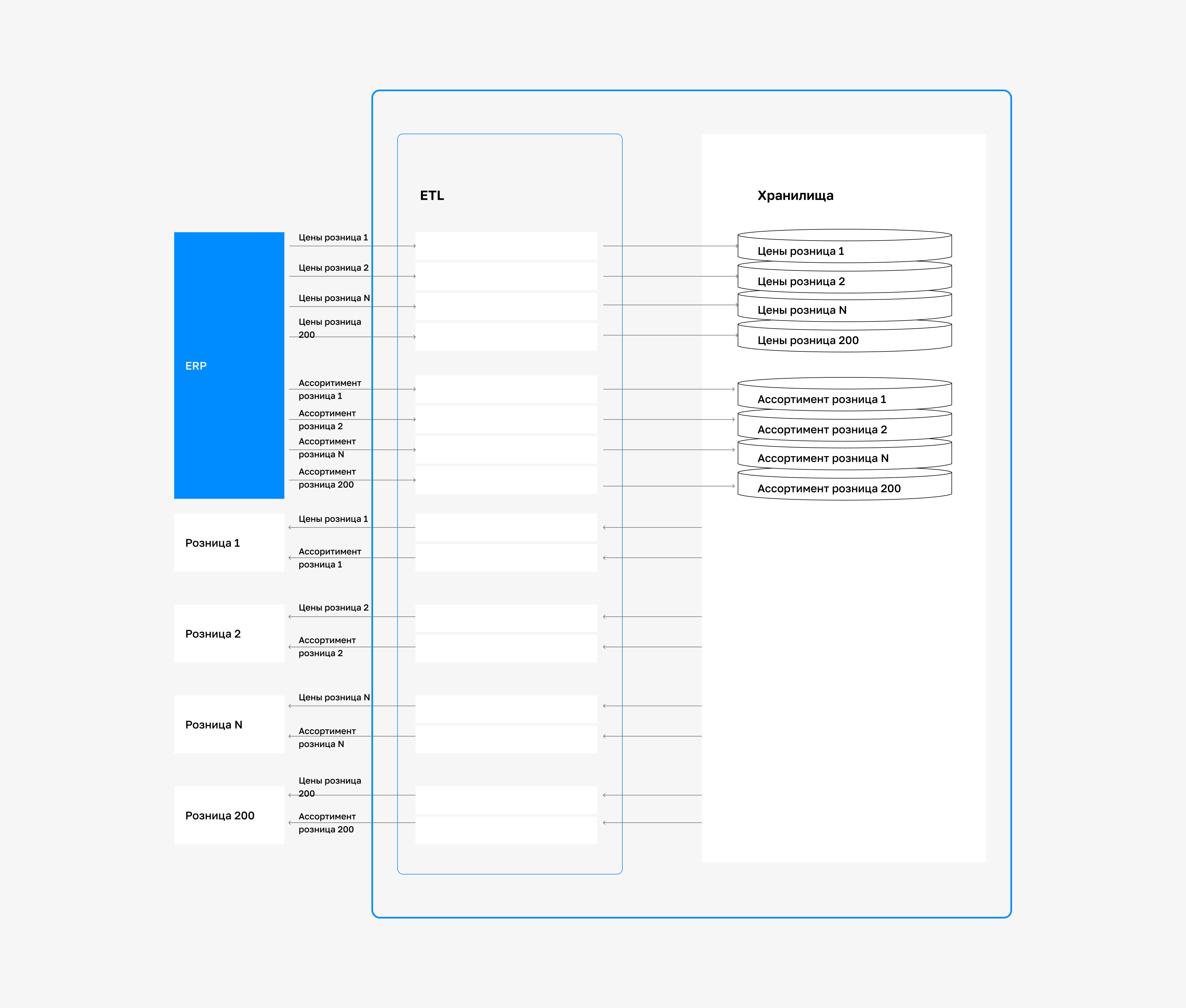
We set up a single customer source and exchange deals↔orders↔invoices↔payments↔stock so managers see current prices, stock, and statuses, and orders from CRM go into 1C without retyping. KT.Team has spent 13 years building enterprise integrations: asynchronous delivery with queueing and retries, exchange monitoring, and connectors that keep working at scale - proven in an environment with 200+ 1C:Retail sites on one API.

Do you need configuration of the 1C:CRM product itself, not integration - edition, pipelines, roles, contact center?

200+1C:Retail locations on one API connector - instead of point-to-point integrations (case study)
13 yearsenterprise integrations: 1C, ESB, data, and accounting core
Bitrix24 · amoCRM · 1C:CRMwe connect any CRM - CRM-agnostic approach
queue + retryasynchronous guaranteed delivery: if the recipient is offline, the event is not lost

What we sync between 1C and CRM

Exchange flow: 1C ↔ connector or bus ↔ CRM

Two-way exchange between the 1C landscape and CRM through a managed layer

1C landscape

1C: ERP, Trade Management, Accountingcounterparties, item master, prices, stock, payments, and shipments

Integration layer

Connector or ESB busqueue, mapping by SKU/UUID, idempotency, retry, exchange monitoring

CRM

Bitrix24 / amoCRM / 1C:CRMsingle customer, deals and orders; the order and invoice go back to 1C

1C ↔ CRM exchange monitor

1C CRM Sales Management for B2B Exchange monitor screen between 1C and CRM: entity rows with exchange direction and status, last session status, message queue, error log, mapping table for 1C item master and CRM products, and a data transfer chart. All values are illustrative. 1C ↔ CRM exchange monitor asynchronous exchange · queue · monitoring Entity Area Status Last sync Counterparties OK 2 min ago Item master 1C→CRM OK 5 min ago Prices 1C→CRM OK 5 min ago Stock 1C→CRM Warning 12 min ago Deal->Order/Invoice CRM→1C OK 1 min ago Payments 1C→CRM OK 3 min ago Shipments 1C→CRM OK 8 min ago Returns Error 20 min ago Status of the last exchange session 12:40 · success · 8 entities Message queue 4 events are waiting to be delivered Growing queue = recipient offline: events are waiting and resent when the node returns - without loss. Error log Error Returns: CRM node unavailable → repeat Warning Stock: warehouse conflict → resolve conflict Mapping: 1C item master <-> CRM products Matching by ID -> by UID -> heuristic SKU Currency Stock VAT rate Status ART-0000 RUB 20% matched ART-0001 RUB 10% by UUID ART-0002 RUB not found Data transfer chart events/min · last 12 intervals Node unavailable -> alert to support The values on screen are illustrative exchange-monitor placeholders, not client metrics.
Exchange monitor between 1C and CRM: entity and exchange direction statuses, last session status, message queue, error log, item master mapping, and data transfer chart. Screen values are illustrative.

Map out your integration landscape

How we set up 1C and CRM integration

  1. 01

    Audit of the 1C environment and CRM

    We review the 1C configurations (ERP, Trade Management, Accounting), the CRM edition, volumes, and exchange entities - and say plainly where out-of-the-box exchange is no longer enough.

  2. 02

    Message contract and mapping

    We define entities and match item master, counterparties, and prices by SKU and UUID: first by ID, then by UUID, then heuristically.

  3. 03

    Connectors or integration bus

    For two systems, a point-to-point connector is enough; for 1C, CRM, the website, and marketplaces, an ESB bus with routing and queuing is used.

  4. 04

    Asynchronous delivery

    Queue and retry with backoff: if the receiver is offline, the event waits and is sent after recovery, with no loss and no duplicate orders.

  5. 05

    Monitoring and alerts

    The exchange is visible in the data transfer chart; node unavailability triggers a support alert instead of silent desynchronization.

  6. 06

    Acceptance on live entities

    We verify deal-to-order flow, payments, and stock on real data, then hand over the setup with documentation and message schemas.

Point-to-point connector or integration bus

CriterionPoint-to-point connectorIntegration bus (ESB)
Coverage1C ↔ one CRM1C, CRM, website, marketplaces, WMS in one environment
Network growthevery new system adds another integration and another point of failurea new system connects to the existing bus through a contract
Recipient failurerisk of lost events and duplicatesthe queue buffers, retries use backoff, delivery is once
Monitoringinside the box, "if it works, don't touch it"Observability and alerts for every exchange
When it is enough2 systems, infrequent updates3+ systems, end-to-end processes, frequent prices and stock updates

Connector or bus - an architectural decision

Cases

Cases: 1C landscape, exchange, and CRM

All cases

FAQ

Frequently asked questions about 1C and CRM integration

How do you set up 1C and CRM integration?

Audit the environment and CRM edition → message contract and mapping by SKU and UID → connectors or integration bus → asynchronous delivery with queueing and retries → exchange monitoring → acceptance on live entities. The exchange follows a message contract, not direct changes inside the CRM package.

What are the timelines for 1C and CRM integration?

Depends on the number of entities and systems in the landscape. As a speed benchmark: we brought the CRM migration for FM Logistic to first users in less than a month after project start. The exact timeline is set after a landscape audit.

What is synchronized between 1C and CRM?

Customers and counterparties - both ways; item master, prices, and stock - from 1C to CRM; deals -> orders, invoices, and payments - from CRM to 1C; shipments and returns. The exchange direction for each entity is configured to fit your process.

How does connector-based integration differ from an enterprise service bus (ESB)?

A point-to-point connector works for two systems. With three or more systems and a growing exchange network, it falls apart - you need a bus with routing, queuing, and monitoring. Using this principle, we built a unified API for a landscape of 200+ 1C:Retail locations instead of point-to-point links. Common mistakes in this setup are explained separately.

Which CRMs do you connect?

Bitrix24, amoCRM, and 1C:CRM. CRM-agnostic approach: the exchange is built around a message contract, so the CRM in the environment can be replaced without rewriting the 1C integration.

How much does 1C and CRM integration cost?

We work on a fixed price for the agreed scope, not by the hour; we confirm the exact price after reviewing the setup - model and pricing guidance on pricing page. Market estimates, such as a one-way export starting at 120,000 RUB, are shown only as market context, not as KT.Team pricing.

Will data be lost if the receiving system is offline?

No. The exchange is asynchronous: the event waits in the queue and is sent once the receiver comes back online, while node unavailability is visible in monitoring - support receives an alert. This is exactly how the 200+ site 1C:Retail environment is built.

Turnkey integration

We will design 1C and CRM integration for your environment

We will review your 1C environment and CRM edition, design entity exchange with queuing, retries, and monitoring, and document the scope, timeline, and fixed price in the proposal. We work on a fixed price for results - model and pricing guidance on pricing page. The choice is yours.

Discuss 1C and CRM integration

Related solutions and materials

  1. Do you need help configuring the 1C:CRM product itself - edition, pipelines, roles, contact center?

  2. This is 1C:CRM implementation.

  3. 1C exchange with any systems through a bus - 1C integration via ESB and overview all 1C integrations.

  4. Why businesses should connect 1C and adjacent systems - in the breakdown how 1C integration improves efficiency; common mistakes in 1C and CRM integration are in a separate breakdown; CRM market and platform shares are in CRM market overview.

Sources

  1. Verification date: 17.07.2026. External links are shown as plain text. The CRM market in

  2. In CIS in 2025 - about 44.1 billion RUB (+25% year over year), 2026 forecast - 47-48 billion RUB, domestic solutions account for over 90% of the market: vc.ru/services/2775011

  3. CRM platform shares (J'son & Partners Consulting survey, November 2025 - January 2026): Bitrix24 49%, 1C 20%, amoCRM 9%: json.tv/news/news-detail-3 Bitrix24 - 250,000+ commercial accounts in CIS and the CIS, two-way exchange with 1C: bitrix24.ru/features/crm/1c

  4. 2026 trend - AI in sales built on a unified data layer, not import substitution as the end goal: trn-news.ru/articles/211725

  5. Market price benchmark (context, not KT.Team pricing): 1C and CRM integration from 120,000 RUB / from 20 business days

  6. for one-way export: intervolga.ru/1c/1c-integratsiya-s-crm

Discuss: 1C and CRM integration for sales

Send via: