Closing KS-2, KS-3, and KS-6: from site volumes to contractor payment

Construction volume closure: site verification, control sign-off, KS-2 and KS-3 forms, 1C accounting, digital signing and payment status tracking.

Our clients

Clients and partners

Capital Group
FSK Group
SMLT
Tochno
Dogma
Sber City
FM Logistic
Danone
Relief Center
Pandora
Contractor Volume Closure: KS-2 and KS-3 Construction Acts
Saint-Gobain
Askona
FIX PRICE
Snezhnaia Koroleva
Muztorg
TVOE
Greenway
Polaris
Campari
Yandex
Lenta
International perfume and cosmetics brand
Contractor Volume Closure: KS-2 and KS-3 Construction Acts
RAEC
EKF
L'Etoile
Inventive Retail Group
7 yearstotal project work with construction companies and developers - a significant share of projects is under NDA, and the cases show only a smaller part of what has been done
2 monthsto the MVP of a single entry point for the developer's contractors, with the service portal another three weeks out
Approx. 200k RUBthe cost of one day of delay on site - a client estimate from our construction control case
4.9xmaterial procurement sped up by 3x for the developer ranked in the top 5 by construction volume, with prepayment; with postpayment, by 3x

Closing does not break on the act form

Five roles take part in month-end closing: the contractor counts completed work on site, site supervision checks it in practice, the technical office reconciles it with the contract estimate, accounting waits for the document, and finance manages the payment calendar. While these roles work in different files and systems, the month closes not on data but on emails and calls.

This creates the same set of problems across all companies: volumes submitted but not confirmed; act compiled but doesn't match contract line items; document sent for signing and vanishes; contractor doesn't understand where their money is and calls accounting. No symptom is solved by a new act form. They're solved by linking the steps—a chain where confirmed volumes become an act, and the act becomes payment without manual transfers.

The entry point into this chain is the estimate and the volumes. How volumes get into the estimate and into the accounting system is covered separately on the page integrating TIM/BIM with 1C. This page covers what happens next: how accepted work becomes money.

Closure workflow: from site volume to payment

Volumes → construction verification → document → 1C → EDM → payment → contractor dashboard

Marketplace

Contractor volume submissionby contract estimate line items, including mobile

Acceptance

Construction control confirms or rejectsaccepted volume for the period, disputed—with reason

Document

KS-2 and KS-3 from confirmed volumescumulatively, per the work completion register

Accounting

1Ccontract, cost, advance offset, warranty retention

Signing

EDMSapproval workflow and electronic signature of parties

Money

Paymentpayment schedule and actual disbursements

Contractor

Personal accountact status, withholdings, payment, reconciliation act
  • Gap 1—volumes submitted but not confirmed The act cannot be prepared: approval is stuck with site supervision, and the period is closed based on promises rather than accepted volume
  • Gap 2—'month with no closure' Work started late, the estimate for new work types isn't ready, there's no contract position—nothing to close, yet crews worked all month
  • Gap 3—closure with negative and positive adjustments Volumes changed between design and working docs: removed and added items must process through one document, otherwise contract, estimate, and actuals diverge
  • Gap 4—manual transfers between systems Construction control, 1C and EDM are not linked: one volume is entered three times, and discrepancies surface during quarter-end reconciliation.
  • Gap 5—contractor can't see status It is unclear where exactly the act is stuck, so the contractor calls accounting, and the technical office gathers statuses manually
The diagram shows a standard closure route. Specific systems are those already deployed at the developer: the goal is to link them into one route, not replace them.

KS stagnation: when there is nothing to close

"A month without closing" almost never means the contractor did nothing. Much more often it is a schedule gap: the working documents for the next type of work arrived later, there is no estimate yet, and no contract line item yet, so there is nothing to close formally, even though crews were working on site all month.

For the contractor, stalled KS processing means a cash gap: wages and materials are paid, revenue is not recognized, and the next tranche depends on closing the previous period. For the client, plan-versus-actual is distorted: progress on the project looks lower than it really is, decisions on deadlines are made on an understated picture, and the next month brings double the closing volume.

This should be fixed not in accounting, but earlier. The system must show discrepancies in advance: which work types lack labor sheets, where estimates aren't ready, which volumes are already confirmed by construction control and awaiting contract items. Then through month-end, you have options—accelerate estimate release, issue a change order, or close the period at claimed cost with subsequent adjustment—rather than explaining post-hoc why the document wasn't completed.


Negative and positive closeout: when volumes have changed

Volumes differ between design and working documentation almost always—a normal project course, not a design error. In closure, discrepancies appear as minus and plus closures: volumes removed from one item and added to another process through one document for the period. The basis is always specific—a revision estimate, design change, or amendment, with author, date, and amount.

For this to work, estimate lines, contract, confirmed volume and act must be line-item linked and survive document re-issuance. Without linkage, discrepancies are compiled in Excel, and after a quarter no one can explain why the contract total diverged from the act total or what change caused it.

A separate discipline—the volumes themselves: how they convert to work and materials, where consumption coefficients come from, and how to handle non-modelable elements. We cover calculation methodology and reference requirements in the article on work quantity statement.

What is calculated around the act besides volumes

KS-2, KS-3, KS-6, and KS-6a: what each form closes

Forms are easily confused, and this determines what gets automated. General work journal—construction control and supervision workflow. Work completion journal—cumulative basis for contractor billing. Act and certificate—acceptance and payment documents.

FormWhat it recordsApproved byWhat matters today
KS-6 "General Work Register"Construction progress: sequence, schedule, conditions, and work qualityCIS Goskomstat Decree No. 71a of October 30, 1997; this form is not in Decree No. 100The form and procedure for maintaining the general journal is defined by CIS Ministry of Construction Order No. 1026/pr of December 2, 2022 (effective September 1, 2023). This is the construction control and supervision workflow, not contractor payment calculation.
KS-6a "Work Completion Register"Cumulative accounting of completed volumes and costs by structural element or work typeCIS Goskomstat Decree No. 100 of November 11, 1999Contractor records volumes based on site measurements. KS-2 and KS-3 are sourced from here—in the digital workflow, this is a table of confirmed volumes, not a notebook.
KS-2 "Work Completion Acceptance Act"Volumes and cost of work accepted for the reporting periodCIS Goskomstat Decree No. 100 of November 11, 1999Acceptance document. It should be built from approved volumes, not re-entered from scratch at month-end
KS-3 "Cost Statement for Work Completed and Expenses"Work value: for the reporting period, year-to-date, and from construction startCIS Goskomstat Decree No. 100 of November 11, 1999The payment document: this is where the advance, its offset, and retentions come together

Map out your integration landscape

What we do

Work scope is assembled for the workflow that already exists at the developer: estimate system, construction control, 1C and EDM remain in place; we link them into a single closure route.

Volume submission from site

Contractor submits completed volumes by contract estimate line items, including mobile submission at the site with photo evidence and building/section reference. One entry—then the volume lives in the system, not in emails.

Construction verification workflow

Each submitted item is confirmed or returned for revision with a reason and deadline. Disputed volumes are visible separately and do not block the rest of the document.

Assembling KS-2 and KS-3 Acts

The act and certificate are assembled from the accumulated log of completed work for the period, with advance offset and retention for warranty. The printed form remains familiar to both parties.

Transfer to 1C

The contract, act, certificate, and retention amounts are transferred into the accounting system without re-entry. Cost and plan-versus-actual for the project are calculated from the same accepted volume as the act.

Signing in document management system

Approval and signature workflow is role-based, not memory-based: you see who has the document, how long it's been there, and what blocks signing.

Contractor personal account

Contractor sees the status of each act, advance credit, retentions, payments and reconciliation statement. The question 'where's my money' is resolved without calling accounting.

Access to site and building

Access is granted for a project, building, and type of work, not to the entire system, and it is revoked by event: dismissal of a contractor employee or contract closure cuts access immediately.

External contractor permissions and access

Contractor employees lack corporate accounts at the customer. This is not an administrative detail but a working condition for the entire route: if only the developer's employee can submit field volume, submission again becomes file exchanges and phone calls.

Three requirements typically emerge last and cost the most to implement. First—single sign-on for all developer services instead of individual passwords. Second—event-driven access revocation: contractor employee termination or contract closure must immediately revoke access, not await the next account audit. Third—fine-grained permissions by object, building and work type: a contractor on one section should not see contract volumes of adjacent sections.

That's exactly what we did. For GK TOCHNO in two months, we launched an MVP unified portal: deployed and configured Keycloak IdP, enabled authentication via the Active Directory master system. In parallel, in three weeks we built a service showcase—the first stage of the dashboard. Before the project, external users had no access at all: information was exchanged on paper, then digitized and reports were built manually, while provisioning internal users took three weeks to two months.

What each system is responsible for

System / layerScope of responsibility
Contractor on siteSubmits actual volumes against contract estimate line items with confirmations. Single on-site entry, not back-office processing at month-end.
Construction controlApproves volumes or rejects them with a reason. The general journal and as-built documentation stay in their domain.
Technical supervision and estimate departmentHolds contract line items and change reasons: revised estimates, design sheets, and addenda. Without them, negative and positive closeouts are impossible.
1CRemains the accounting system: contracts, KS-2 and KS-3, advance setoff, retention guarantee, cost, and payments.
EDMSResponsible for signature workflow and legal validity of the document, not volume calculations.
Contractor personal accountA single window for the external participant: act statuses, retentions, payments, documents, and reconciliation statement.
KT.Team integration layerLinks workflows: reference data mapping, line-item identifiers, bus and API exchange, exchange log and discrepancy control.

Experience

KT.Team cases in real estate development

Read all

What this delivered to our clients

In a construction planning and control system for a developer in CIS's top five by construction volume, site reporting stopped being monthly: data began arriving two or three times a week instead of once a month. For a client where every day of delay on one project costs about RUB 200k, that is the difference between reacting in time and acting after the fact.

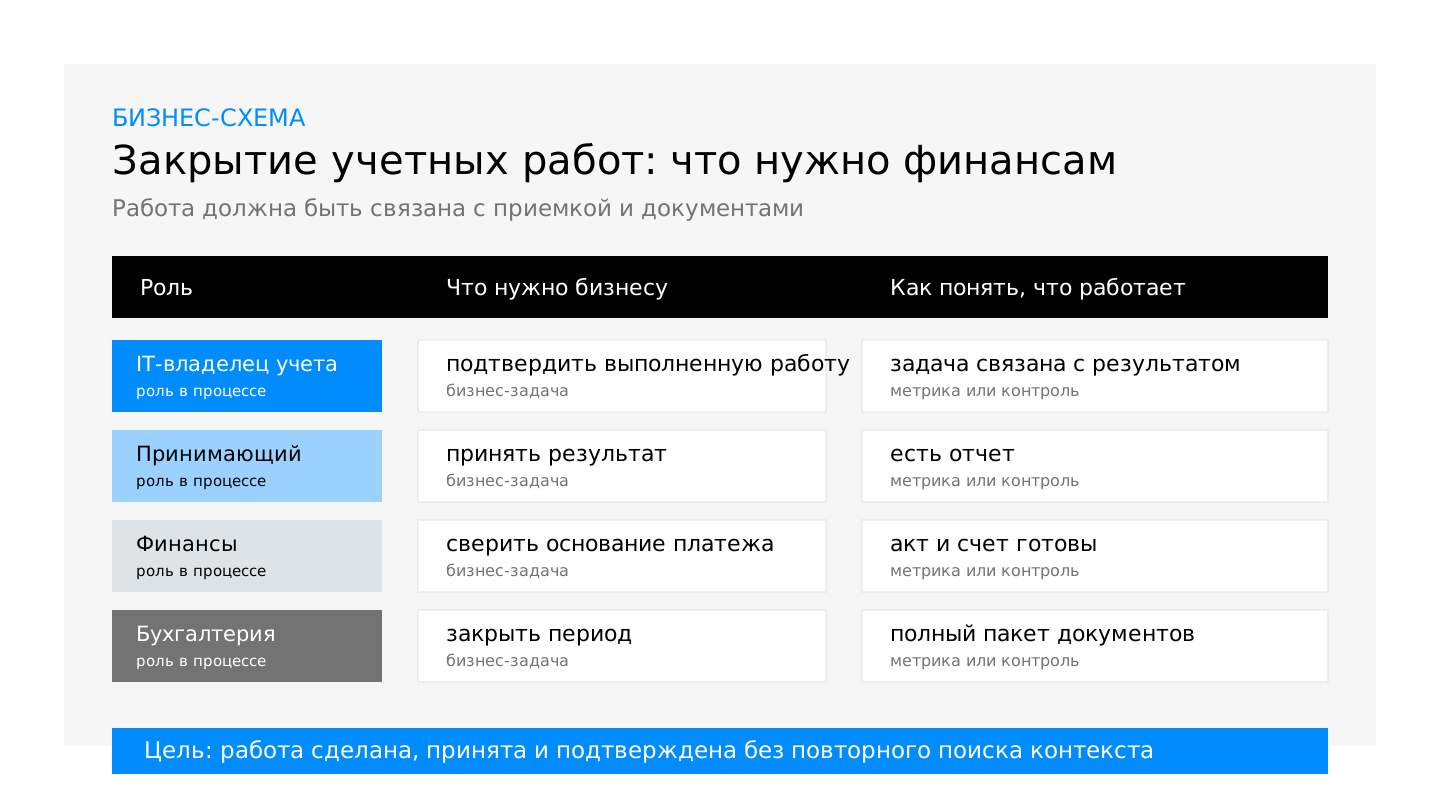
In a developer's accounting close project, completed work was linked to the report, act, invoice, and UTD as a single confirmation package: finance can see exactly what was accepted and what supports it, without separately checking the context for each item.

In a material procurement project for a developer of the same class, prepaid purchasing became 4.9 times faster, and postpaid purchasing 3 times faster. The adjacent task in the same system is construction materials procurement automation.

Trust

Client reviews

All reviews

The KT.Team team is a mature development partner. The delivery process is very clearly organized, and the smooth collaboration within the engineering team deserves special mention. When the team sees that the development process needs fine-tuning, it does it. During discussions, the team digs into the essence of the tasks and seeks to understand the business context. The work is aimed not at formally fulfilling the specification but at solving the real problem. Thanks to strong engineering expertise and product thinking, the team can be trusted not only with implementation but also with the architecture of the entire system.

Contractor Volume Closure: KS-2 and KS-3 Construction Acts Vadim MizhenskyHead of Digital Product Development, FSK Group

The Muztorg group of companies has been working successfully with the KT.Team team for more than two years. The high professionalism of our partners helps us a great deal, as does their ability to combine well-structured project management with minimal formal constraints. I would especially like to note the friendliness and openness of the KT.Team staff.

Contractor Volume Closure: KS-2 and KS-3 Construction Acts Dmitry SavelievBoard Advisor on Digital Development, Muztorg

You set a high standard for working with contractors. After you, dealing with others leaves a feeling of falling short of expectations.

Contractor Volume Closure: KS-2 and KS-3 Construction Acts Dmitry StolbovCEO, MechTech Ecosystem

How to launch the closure workflow

  1. 01

    Workflow review

    We trace the actual path from field volume to payment: where confirmation occurs, where data is entered manually, where documents await review. Result: route map and list of gaps with their costs.

  2. 02

    One object and one work type

    We run end-to-end closure on a narrow band: submission, approval, act, transfer to 1C, signing, status in contractor portal. The tight loop delivers measurable results in weeks, not a year.

  3. 03

    Data and access rights

    We establish line-item linkage between estimate, contract, volume and act; a change reason reference; and a contractor access matrix by object and building.

  4. 04

    Roll out across the portfolio

    Add remaining sites and contractors, enable KS stagnation reporting and variance control between contract, acts and payments.

FAQ

Frequently asked questions about KS closure

Do we need to change 1C or EDM?

Usually no. Accounting stays in 1C, signatures in EDM, construction control in its system. We build a workflow between them and add what's missing from the process: site volume submission, verification, and contractor dashboard.

Must we use exactly the KS-2 form?

The unified form itself has not been mandatory since 2013; contractor agreements make it mandatory, as do government customer contracts and internal regulations. Precise grounds and Finance Ministry citations are provided above in the regulatory section.

Contractors won't use mobile—what then?

Mobile submission is needed where volumes are counted on-site. Other scenarios close via web dashboard and contractor file import; the key difference is that after submission, the volume enters one workflow, not email.

Where to source volumes if there's no estimate model?

From the designer's specification and the work quantity statement. The methodology is in the article on work quantity statement, and the route to the accounting system is on the page integrating TIM/BIM with 1C.

How is closure linked to procurement?

Through contract volumes and delivery schedule: closure shows what was actually accepted, and procurement shows what backed it. Adjacent workflow— construction materials procurement automation.

Where to start when the developer has many tasks?

From the process map and financial gap priorities. The developer's full task scope is collected in development digitalization.

KT.Team service

KS-2 and KS-3 closure workflow tailored to your process

We analyze your current workflow from site volumes to payment and link construction supervision, estimate module, 1C and document management into one route—with act status in the contractor portal.

  • We work with the systems you already have
  • First end-to-end closure on a single site and work type
  • Contractor access to site and building, revocable by event
Discuss closure →

Sources

Discuss: KS-2, KS-3, and KS-6 closure: from volumes to…

Send via: